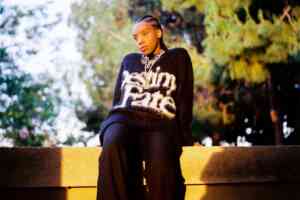
Neu Dua Saleh: “I’m constantly confronting myself and confronting the world”
The musician and Sex Education star guides us through their apocalyptic R&B debut: a parallel of toxic love and the decaying environment.
“I think we’re in a relationship with the earth,” asserts Dua Saleh. The musician and actor hasn’t even had the chance to have their morning coffee, but they’re up at the crack of dawn in LA to talk to DIY about the slow decay of our planet. “We found ways to exist and to grow and to learn from the earth. But now the earth is responding to our toxicity – and we’re quite literally crumbling.”
Those are the lofty stakes at play on Saleh’s debut, ‘I SHOULD CALL THEM’. Though they’re best known for their groundbreaking role as non-binary character Cal Bowman in Netflix’s Sex Education, Saleh was first and foremost a musician, having released their debut EP ‘Nūr’ in 2019. Now, the Sudanese-American polymath has returned with an album that appears to celebrate the ups and downs of chasing love in your twenties. But, as hinted at by the extraterrestrial aesthetics and dark mood, there’s a deeper allegory at play: environmental chaos.
Recorded right after Saleh wrapped Sex Education’s final season, they note that the parallels in Cal’s narrative arc and their own lived experiences began to seep through to their music. “[That] season made me reflect on my mental health issues and where I was as a kid in uni,” they explain. “And I think I really legitimately had the same experience. So there’s a lot of Cal in my music.”
Though they more explicitly explored that link in 2021 EP ‘Crossover’, it prompted Saleh to reflect on their past relationships. Among the dystopian landscape of ‘I SHOULD CALL THEM’, Saleh’s ballads about love are the most true to reality in the record. “On this album, the experiences that were most important to me were the human experiences,” they say, citing the “bliss and joy that queerness can offer to sapphic couples, and maybe the toxicity that’s a little cheeky and the naughtiness that comes along with being in your twenties and figuring out how to date and not be an asshole.”
At the same time, Saleh began connecting their love life with their relationship to the planet. As they were recording their debut, the Dakota pipeline was being built through their home state of Minnesota, and the Sex Education set in Wales was hit with huge floods. “There was a lot of environmental decay that I was constantly being met with,” they recall. As such, Saleh’s love story is set in an apocalyptic version of earth, which deteriorates around them.
“There’s a lot of metal music at the end [of the album] – which is kind of a lot,” they laugh. “But I think that’s me articulating sonically through the production that the earth is falling apart. These two lovers are intertwined at the end of it, embracing each other as the world [crumbles] – and that’s kind of what we’re doing with earth.”
“I feel like a way for us to be compassionate to one another is to care about the environment.”
‘I SHOULD CALL THEM’ uses fantastical visuals not only as a means of escape from the dreary realities of the world, but also as a way of recentering the self. People of colour and trans people, Saleh explains, are often denied their basic humanity through various forms: access to care, and kindness from others, to name but two. For them, futurism is “a way to reorient yourself and to allow yourself to have a spacious understanding of your full creativity.”
They cite the doctrines of Afro-futurism and animé as ways of unlocking this potential. “It’s these characters transforming into figures that have huge muscles or have wings or can fly, and [through them] I’m able to tap into infinite forms of sacred wisdom and knowledge. I think that’s something that a lot of trans people have access to and that they already are doing constantly, which is why queer people are so artistic.”
‘I SHOULD CALL THEM’ is also a love letter to R&B, and incorporates a multitude of genres along the way including jazz and hyperpop. Saleh says it’s a way for them to “heal that younger version of myself that wanted to be Ray J,” they laugh. “I wanted to be an angst-filled R&B lover boy. I haven’t really consistently stuck to one genre, and I wanted to challenge myself to see if I could showcase my loving sentiments towards R&B in a way that expresses the full breadth of my humanity.” Though there are few non-binary people working in R&B today, Saleh says there’s a lot of room for queer expression within the genre – and that extends to the guests they recruit. Gallant uses his incredible falsetto to “hit notes that are higher than I could probably reach”, while Ambre is able to intone “bass-filled notes”.
The album is an interesting full circle moment for Saleh. Having studied pop culture as a specialism at Augsburg University, they acknowledge the irony of now being part of it from their specific vantage point. “I feel like there’s a lot of my unique experiences that have led me to be critical of what’s happening in the world,” they explain. “I studied GWSS [Gender, Women, Sexuality Studies] and sociology. So I’m constantly confronting myself and confronting the world with critiques that will shine a light on our love for one another. And I feel like a way for us to be compassionate to one another is to care about the environment.”
But ultimately, Saleh insists that despite its dense narrative, their music is a part of a core mission to bring that love to everyone. “As a trans non-binary person, I see that there are not many places for trans and queer people to breathe in this political landscape,” they say. “I’m hoping that my music will offer people a break from that: to sing along to my songs, and not feel like they’re being consumed by the propaganda machine that’s working to actively kill us off within society at this moment.”
‘I SHOULD CALL THEM’ is out now via Ghostly International / MNRK Music Group.
Records, etc at



Featuring Yard Act, Death Cab For Cutie, Graham Coxon, Maisie Peters and more.