Neu Get To Know… Ain’t
Sweaty-ceilinged, scuzzy alt-rock that begs to be heard live.
Hello and welcome back to DIY’s introducing feature, Get To Know… which aims to get you a little bit closer to the buzziest acts that have been catching our eye as of late, and working out what makes them tick.
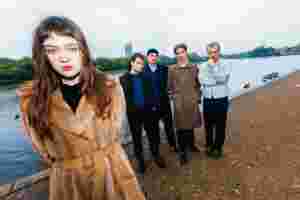
This time, we’re diving head-first into the past, present, and dystopian hellscapes of Ain’t, the South London band who’ve been causing quite the stir of late, courtesy of their instantly compelling, ’90s-imbued brand of alt-rock (just don’t say it’s shoegaze).
Comprised of Hanna Baker Darch (vocals), George Ellerby (guitar/vocals), Ed Randall (guitar), Joe Lockstone (drums), and Isaac Griffiths (bass), the five-piece have been peddling their wares around the capital’s live circuit (and beyond) since 2024, refining their amalgamation of lo-fi grunge, Midwest emo, and dream-pop with each new single - which, together, will make up their forthcoming six-track vinyl EP ‘How They Faked The Moon Landing’. Ahead of its arrival, the band talk us through their musical origin stories, learning curves, and favourite historical periods. Naturally.
If Ain’t was a TV ad, what would your tagline be?
Beating the shoegaze allegations, one gig at a time.
Growing up, what were your musical educations like? What was on the radio/in the car/at home/on your iPods? Give us an insight into those formative years.
HDB: My mum is an avid enjoyer of BBC Radio 1 (no adverts, pop music), which she sings along to and plays constantly when my dad’s not in the room. Growing up, he was an iPod/CD mixtape aficionado (and snob), who from a young age taught me how to download discographies very legally from, *ahem*, imelay ireway, and make a hobby of burning playlists onto disks - something I actually still do today, but through the decidedly less dodgy medium of Bandcamp.
I’d also like to mention my grandparents, who had a large hand in bringing me up on camp Hollywood musicals and feel-good records they kept from the ‘60s onwards - I cannot understate the influence of Doris Day, Barbara Streisand, or The Ronettes on my vocal or hair aspirations.
JL: My music taste started with Guitar Hero 3: Legends of Rock (on the Wii). This was music’s transition from background noise to art, providing a masterclass smorgasbord of well-curated rock music on a disk. There were the blistering highs of Bloc Party’s ‘Helicopter’; the conviction that I was sticking two fingers up to the man whilst miming along to Rage Against the Machine in my living room; and the crushing beauty of Metallica’s ‘One’. Eventually, the plastic guitar was ditched for the real thing and I’ve looked back often.
ER: I feel very envious of people who grew up surrounded by their parents’ massive, immaculately curated record collections because I definitely did not do that. I know now that my parents liked a lot of great new wave stuff but for some reason they didn’t feel the need to give me any pointers at the time, so I ended up with whatever was playing on the radio while we drove around.
By the time I was 8 or 9, a boy from my school had plastered his room in My Chemical Romance and Slipknot posters, and before long I too had found myself straying over to the wrong side of the music channels. Rock was now my calling. I proceeded to fill my iPod with some of the most puerile, boneheaded dreck I could lay my hands on and for a while things were looking pretty ugly. A minor miracle later occurred when I came into possession of a copy of ‘Turn On the Bright Lights’ via a track on Guitar Hero 4, and my tiny mind was blown wide open. It felt like having my brain re-wired in real time. I have not recovered.
GE: I fortunately grew up surrounded by my parents’ massive, immaculately curated record collection, which played a very important role in my music education. My dad was a ‘70s punk, my mum was an ‘80s mod, and they were married in the early ‘90s, so I was encouraged from a very young age to listen to the likes of The Clash, The Jam, Echo and the Bunny Men, The Jesus and Mary Chain, and The Specials. My Dad also worked at HMV during the golden years of the CD, and – once I was a teenager – I had a formidable collection of late ‘80s and ‘90s bands to work through.
“We’ve grown as writers, tightened up as a live unit, and managed to avoid releasing anything too embarrassing in the process.”
You’ve built a formidable word-of-mouth reputation since you started drip-releasing singles in 2024, but haven’t rushed anything when it comes to recording a longer project. Can you tell us a little bit more about this approach - do you view Ain’t as a live-first band? Do you think you’ve evolved in any significant ways since your debut single? Are there any pearls of wisdom you’ve gained along the way?
I would love to tell you that taking our sweet time and only releasing a track once every four or five months has been part of some brilliant and calculated masterplan, but I would be lying through my teeth. Truthfully, it seems like two or three times a year is about as often as we’re able to get our collective shit together well enough to go and commit to time in the studio. So it’s been a slow education.
I think we are all quite grateful for the time and space our poor organisation has allowed us. It feels like a very different band from the one that released ‘Oar’ 18 months ago. We’ve grown as writers, tightened up as a live unit, and managed to avoid releasing anything too embarrassing in the process. We’ve had the chance to test the waters with three very brilliant and very different producers, so we’re much more comfortable as a band in the studio and able to approach recording with a much clearer sense of what we want out of it.
Whether we consider ourselves a live-first band is a good question. The answer will probably change depending on whether our last gig was any good. Currently: no. That said, I’m definitely a big believer in the importance of road-testing your songs before committing them to record. Sometimes you have to be really unsentimental about it: we played our first gig with a set of five songs that had been written in total isolation, and almost none of them survived contact with the stage lights. It’s sad but it’s necessary.
For better and for worse, I think we’re now more conscious of how a song will feel to perform right from the earliest stages of writing. Perhaps that makes for a more inhibited writing process, but the benefit of some self-consciousness is a more brutally honest understanding of where our strengths lie. We know each other so much better as people and players than we did before, which means we’re able to push each other further; it’s been nice to feel the envelope of what’s creatively possible for Ain’t gradually widen over time. Fugazi have been preaching all of this for decades, but humility really is something you need to practice through trial and error - nothing gives you that opportunity quite like live performances.
As for pearls of wisdom gleaned along the way, the pick of the bunch comes from Ali Chant, our producer on ‘Long Short Round’ and ‘Grazer’: “check your tuning”.
Your new single, ‘Grazer’, asks the central question “What’s the point in hell / If it doesn’t end?” What would your own personal hell look like? And who would soundtrack it?
You’re standing in London Euston on a humid weekday afternoon. The air is sticky and you have already started to sweat in a really undignified way. The station is packed to the gills because no one’s going anywhere because all the trains are cancelled. Especially yours. Every screen in the departure hall is lit up like the inside of a nuclear reactor, and every single one is cooking adverts for AI-generated investment apps directly onto your retinas. Somewhere through the mass of bodies a man in a flat cap (or perhaps fedora) starts playing Tones and I’s ‘Dance Monkey’ on a saxophone, skronking away like a water bird in distress. Everyone else around you thinks this is brilliant for some reason. Some of them are even dancing. You want to move because you’ve found yourself a kernel in this dancing mass, but you are carrying every single piece of musical equipment you own and for some reason today they’re made of lead. An alarm on your phone starts ringing and nothing you try can switch it off. Now a baby is crying. You are so hungry and helpless and desperate for a piss. There’s only one way out of here and it’s a rail replacement bus to Birmingham. The only remaining seat is next to your least favourite ex.
“The benefit of some self-consciousness is a more brutally honest understanding of where our strengths lie.”
If you could time travel back to one decade in history, which would you pick (and why)?
ER: 1960s. Ten full years to hone my craft before I muscle my way into (Randall) Emerson, Lake and Palmer on second percussion.
JL: 1950s. So I could chase a hoop down the street with a stick without judgement.
IG: 1980s. Queen at Live Aid. The Clash and Pixies in their prime.
HBD: I’ve not been able to come up with a single answer - history is too mysterious. The 1170s or 1180s seems an obvious choice - Angevin courts are a personal fascination - but would I regret not choosing something else? Stradivarius’ workshop in the 1710s? The disappearance of the Roanoke colony? Stonehenge, or better, Newgrange? Honourable mentions go to the embalming of Xin Zhui, the construction of Lalibela, and anything relative to the biblical book of Exodus.
What’s In and Out for 2026?
In: Ants in the kitchen. Flossing, moisturising; showing up to band practice on time. Ants in the bathroom; entomology. Sitting, reading, whittling; calling your mum to tell her you love her; mid-level strategy card games (about political coups or fishing); shoes with proper arch support. Magazines; symmetrical piercings; ginger beer.
Out: Hopefully ants. Landlords, rising damp, landlords who won’t fix your rising damp; social media; neo-fascist homesteading. Doomscrolling, ChatGPT; kombucha; Thames Water; tyrannical warmongering. Ballet flats.
Finally, DIY are coming around for dinner - what are you making?
HBD: Assuming the entire DIY team is invited (of course you are) and I’m making dinner for more than five people, the only obvious choice is a huge Sunday roast. I make a very mean stuffed pumpkin that could easily feed a small village, and have inherited a partiality for my dad’s (un)traditional cauliflower cheese with leeks and courgettes. There will be a huge tray of roast potatoes in olive oil and polenta, Yorkshire puddings, glazed root trimmings (beets, carrots, parsnips) and, naturally, litres of mushroom and marmite gravy.
ER: Spaghetti. Lots of olive oil, lots of lemon, lots of garlic, lots of black pepper. Perhaps an anchovy or two if I’m feeling wild.
JL: Sautéed sea bass, crispy potatoes, asparagus, lemon and herb butter.
GE: Cheesy beans on toast :)
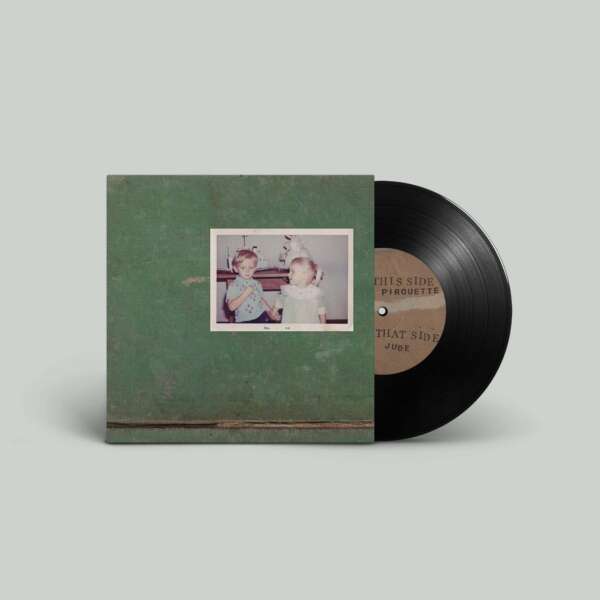
‘How They Faked The Moon Landing’ (Dinked Early Doors Edition) is out on 22nd May via Fear Of Missing Out Records.
Records, etc at

Ain't - Pirouette / Jude
Featuring Finn Wolfhard, FLO, Jungle, Mystery Jets and more.