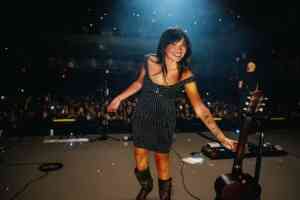
Cover Feature beabadoobee: The Fame Game
From viral moments to internet toxicity, via misogyny, teenage mistakes and the Taylor Swift whirlwind, 24-year-old beabadoobee has experienced it all. About to round off her biggest year so far with a sold-out UK and EU tour, she reflects on the world’s most renowned double-edged sword.
“I was never meant to have this many people looking at me,” Beatrice Kristi Laus states simply. “I can say that for a fact. I’m not used to being… I don’t even call myself famous, but [I’m not used to] people giving a fuck about me, basically.”
She might not use the phrase herself, but Bea - better known by her stage name, beabadoobee - really is, by anyone’s metric, pretty famous. One of the OG stars of the last decade’s bedroom-pop explosion, she shot to cult stardom as a teenager after uploading her debut single ‘Coffee’ to YouTube in 2017 - a track that quickly saw her get scooped up by The 1975’s label Dirty Hit, and which has since had a second turn at virality after Canadian rapper Powfu sampled it for his TikTok megahit ‘death bed (coffee for your head)’. To date, it’s been streamed over 1.7 BILLION times on Spotify alone. As beabadoobee, Bea has sold out shows all over the world, had a UK Number One album with this year’s ‘This Is How Tomorrow Moves’, and was the main support to Taylor Swift - perhaps the most famous person on the planet - for the first US leg of her Eras Tour.
Essentially, people do give a fuck about her. Quite a lot of fucks, actually. And so when she picks up the phone to DIY, having just wrapped on her own US headline dates in support of her chart-topping third LP, it’s hard not to warm to her complete lack of either pretension or self-censorship. “My cat just keeps chewing the hair off her bum. It basically looks like she has a Brazilian,” Bea laughs, explaining that she’s got an afternoon of vet appointments and errands ahead of her. Ah, the glamour of the music biz. She smiles: “It’s honestly the most humbling, but nicest experience. The thing I miss most while I’m on the road is normality.”


Across ‘This Is How Tomorrow Moves’, that feeling of homesickness crops up more than once; atop ‘California’’s scuzzy instrumentation, she sings of the mental strain of living out of a suitcase, while the aptly named ‘Coming Home’ is a waltzy, ‘60s-tinged love letter to domestic life. Ahead of the album’s arrival, Bea made the blanket decision to cap all her touring stints, ensuring that she’d no longer be away from home for more than three weeks. “I’ve been touring since I was 18, so I’ve had my fair share of tour meltdowns,” she explains. “I’ve cancelled shows; I’ve done the whole ‘having a panic attack on stage’ thing. And it’s not cute. I don’t think it was my fault - obviously there was a part of me that felt like I HAD to be on the road and promote my album - but then you realise that your mental health should be prioritised.”
Conversations around performance-induced burnout have been far more prominent in the public consciousness in recent years - just look at Chappell Roan, who has been staunchly (and rightly) unapologetic about cancelling numerous dates on her Midwest Princess Tour, or The Last Dinner Party, who have similarly pulled out of or rescheduled shows in order to give themselves a much-needed break. And make no mistake, such decisions aren’t taken lightly: nobody, Bea says, is more aware of their obligation to fans than the artists themselves. “I was so disappointed in myself every time I cancelled a show,” she says. “I felt like shit and just thought, ‘Everyone’s going to hate me’. I was overwhelmed and overworking myself, and got to a point of extreme exhaustion. I’ve pushed through illness and depression to play a show, and it doesn’t make anything better. But [when I cancelled dates] I’d have to turn my phone off and not read comments, because people would get so angry.”
This sort of reaction represents a darker side to fan culture - a side which, thanks to social media, has proliferated into something strangely close to trolling. Platforms like Instagram and TikTok trade in the illusion of intimacy: in some cases, this means that fans develop a sense of entitlement over artists’ behaviour and off-stage lives. “People like to plant a personality onto someone they don’t know,” nods Bea. “There’s a weird parasocialness that I’ve noticed this generation of kids have with musicians in the public eye. And if you don’t meet their expectations - if you don’t meet their idea of what they think you’d be like - you’re a horrible person.” And, as Chappell Roan has pointed out, these are expectations that are far more frequently projected onto female artists than they are their male peers.
“I think it’s really easy to find a woman way more annoying than to find a man annoying,” Bea muses today. We have to adhere to more societal expectations than men do, and if we don’t meet that mark we immediately get faced with backlash.” She posits: “‘Oh, she’s a bitch!’… no, I was just standing up for myself.” Along with ‘annoying’ and ‘bitch’, we suggest, there are a whole host of adjectives levelled at female artists that are inherently gendered: ‘bossy’, ‘diva’, ‘high maintenance’, ‘hysterical’. “I still see comments like that,” she nods. “All those words are so female-driven - they all contain this sort of underlying shade [towards women].”
Like her indie/pop contemporaries Rachel Chinouriri and Cat Burns, who have recently released a song, ‘Even’, on the subject - Bea also exists in the crosshairs of racial stereotyping. “As an Asian woman, I feel like there’s a pre-judgement or an expectation on how I’m meant to act,” she shares. “I’m meant to be very behaved; I’m meant to make classical music; I’m meant to shut the fuck up and not swear and not be loud. So on top of being a woman, I also have societal expectations of my race.
“There’s a lot of shit we have to carry, but I don’t want that to be the reason that I have to hide my true self,” she continues. “Yes, I probably have to make twice the effort. But I don’t want to change myself just so [other people] can listen to me or be more interested in me. I just want to be a true, honest version of myself. And if people find that annoying, they find that annoying.”
Much has been made in recent years of redressing the music industry’s gender imbalance, especially with regards to festival bookings. Last month, Barcelona’s Primavera Sound unveiled its 2025 lineup and, as well as featuring the likes of beabadoobee herself, FKA twigs, and Haim high up the bill, it sees three female pop artists - Charli xcx, Chappell Roan, and Sabrina Carpenter - at the top. From where we’re standing, the booking feels significant; a major European festival acknowledging that “the three most important artists of the moment” (as stated in a Primavera press release) are women, and thus legitimising female and LGBTQ+ fans - who are frequently derided and dismissed - as significant shapers of culture.
But as someone who’s been inside the music business machine since she was teenager, does Bea actually feel like there’s been much tangible change? “Man,” she sighs. “People say, ‘It’s getting better!’ But I think people are just hiding it better. Pop girlies are ruling the industry right now. I think that’s empowering in itself, and obviously it is an improvement, but it still doesn’t mean…” she pauses. “I think the only change is that women are getting more confident, and women are being more outspoken. We don’t stand for shit anymore. If I feel disrespected, I’m gonna say it - and I remember being 18 and not saying it. In my opinion, that’s the change.”
Personally and professionally, Bea has come a long way since she was 18. “There [were] so many moments where I felt like my ideas weren’t taken seriously,” she recalls of those early days. “I feel like I didn’t even notice it at first because I was just so timid. I basically felt like a punching bag at points.” On those first tours, too, she became “quite lost”. “It got quite sad - I’d be getting really fucked up in my room, I’d be taking drugs I didn’t wanna take,” she shares. “I was young, and I didn’t have my parents around. I was just a confused kid trying to navigate this strange new life. Boys didn’t even look at me when I was a teenager, and [then] there was all this newfound attention that I just didn’t know how to handle.”
Going through the usual teenage rites of passage - experimenting with substances, exploring your sexuality, resisting authority figures - is a rollercoaster regardless; add in constant upheaval, skyrocketing public attention and a tireless work schedule to that hormonal cocktail, and it’s no wonder it all felt so overwhelming. “100%,” she nods. “Everybody goes through it, every teenage girl. But imagine being thrown onstage aged 18, after living your whole entire life not being looked at, and now everyone’s looking at you. And on top of that, boys want to kiss you! That had never happened ever in my life. So I think [intoxication] just made me more confident. I just felt like I needed something to bring me out of my shell more.
“But,” she continues, “I wouldn’t be the person I am today, and I wouldn’t be doing the tours I’m doing if I hadn’t gone through that. I feel like the best way I learn is by making mistakes and learning from them.” These days, Bea has “[her] head way more screwed on”. Staying sober on tour (“California sober, to be fair,” she laughs) lets her be more present with her fans, band, and crew. Now, when she does let her hair down, “it’s more like a fun treat.”


If 2020’s ‘Fake It Flowers’ was an angst-fuelled opening statement proper, and 2022’s ‘Beatopia’ was a more expansive, coming of age affair, then ‘This Is How Tomorrow Moves’ is the sound of Bea firmly staking her claim as one of her generation’s defining voices. Both bolder and more nuanced, her latest represents a distinct maturation: lyrically, she takes accountability and displays astute self-awareness; sonically, she pays homage to her well-worn touchstones (specifically, ‘90s alt-rock and cult songwriter-pop) whilst re-casting them in her own mould.
Its conception was also the first time Bea had broadened her collaborative horizons beyond longstanding creative partner Jacob Bugden to include another producer - namely, music legend Rick Rubin. But, she explains, heading to Malibu to work with Rick at his hallowed Shangri-La studio initially represented a huge leap of faith (an experience immortalised by album standout and Bea’s personal favourite track, ‘Beaches’). “You get people who are out of your world who work on a song with you, and they just make you feel like shit. Rick was the first person [beyond her team] who made me realise, ‘Oh, maybe I am a good songwriter’. It was everything I needed and more.”
Being co-signed by one of the industry’s most celebrated minds can’t do bad things for the old self-confidence, but in her time Bea’s also learned that dwelling too much on external noise - particularly from the online world - is a fool’s game. Talking about her relationship with social media, she reflects: “I’m in a very blessed position where I can get someone else to post for me. I’m so appreciative of all the lovely comments, but the internet has gotten so much grosser recently; I don’t like going on Twitter because of what people say about me. I feel like lots of kids online don’t understand that people in the public eye have emotions and feel like shit too. People fucking forget that.” She pauses. “People can say ‘ignore it’, but that’s way easier said than done.”
For Bea, the key to “doing alright in music, mentally” is to remember that “all those comments and all those opinions people have just live on the internet. None of it is fucking real; as soon as I turn my phone off, I get to go out and have fun and hang out with my friends. It makes me realise that the internet is just a tiny fraction of my life.” And having the room to flick that switch - to log off from beabadoobee and just live as Bea - is something that she’s incredibly grateful for.
Supporting Taylor Swift opened her eyes to a world that most of us can hardly fathom; as well as being “awesome” and giving her “SO much respect for [Taylor]”, Bea also admits that the experience “freaked [her] out”. “It did make me appreciate that I can go out and get fucked up in Camden, and people won’t recognise me,” she says. “With the music I make, I think it’s almost impossible to get to a point where I can’t be out in public; most of it is definitely for an acquired taste, I think.” This slightly left-of-centre positioning allows Bea “to just make the music [she] wants to make and still have a completely normal life, living in a flat with two cats and [her] boyfriend.” She shrugs: “People don’t really care - I can go into a pub, I can go to Tesco and look shit. It’s just strange that on the internet I feel so loud; as soon as you turn your phone off, it’s just irrelevant.”
Though certainly not the case for everyone, it’s perhaps because Bea was lifted up so young that her feet remain so firmly on the ground. When she first started playing shows herself, she’d only ever been to two gigs as a punter: One Direction, and Tame Impala at Alexandra Palace. Now, she’s gearing up to headline a sold-out Ally Pally herself. “It’s kind of a trip going back - I haven’t been there since,” she says with a smile. Going from attending a 10,000 cap venue in your hometown to standing on its stage is an undeniable milestone, but to Bea, it’s what HASN’T changed that will make the night all the more special. “All the friends I have are still the same girls I knew since I was 10, and they’ve been to every single London show I’ve played. They still treat me the same, they still take the piss out of me.” She mimics being teased for developing a slight American twang whilst over in the States. “It’s really important to have them there - the people that knew me before.”
As conversation turns to Camden (“It’s always going to be a good night”), costume snobbery (“The one outfit we should delete off the face of the Earth is sexy schoolgirl”) and that night’s Halloween Soft Play gig (“I’m going as a cheetah - there’s a lot of faux fur”), it’s obvious that the down to earth authenticity and genuine warmth that makes her work as beabadoobee so beloved isn’t going anywhere, no matter how high her star rises. “What I craved growing up was seeing a girl that looked like me that just fucked up all the time but learnt from every mistake she made,” Bea laughs. “I think it’s important to be honest, and that’s what I’ll continue to do. I genuinely can’t help it.”
‘This Is How Tomorrow Moves’ is out now via Dirty Hit.


More like this

beabadoobee shares new ‘Pylon’ preview in the form of ‘Switchblade’
It marks the second cut to be lifted from her forthcoming new album, which is due for release this September.
15th July 2026

beabadoobee launches star-studded fourth album ‘Pylon’ with jagged new track ‘Sun Has Set’
The star has also announced details of her first ever arena tour.
25th June 2026

beabadoobee returns with striking The Marías collab ‘All I Did Was Dream Of You’
It’s her first new music since the arrival of third album ‘This Is How Tomorrow Moves’ in 2024.
12th March 2026

DIY’s Albums of the Year 2024
Our definitive guide to the year’s best music.
13th December 2024

Featuring Yard Act, Death Cab For Cutie, Graham Coxon, Maisie Peters and more.