
Cover Feature Djo: The Long And Winding Road
When you spend your days acting and your nights performing, it’s not hard to get lost in the liminal space. Throw in a significant breakup, an untethered lifestyle and unprecedented online attention, and the fog gets even thicker. On his third outing as Djo, though, Joe Keery is retracing his steps and moving forwards.
Joe Keery knows a thing or two about existing between the lines. To some, he’s best known as Steve ‘The Hair’ Harrington, the cult fan-favourite character of OG Netflix juggernaut Stranger Things. To others, he’s the ‘End of Beginning’ guy - a sleeper hit that so perfectly captures the fond melancholia of returning to a once-significant place, it became 2024’s sixth most streamed song globally, racking up 1.5 billion plays (and counting). He grew up in Massachusetts, but moved to LA and is now based in New York; he spent his formative college years in Chicago, but his family are still back in Boston; his acting career has led to temporary stints in Atlanta, Italy, and Canada, while being a musician has taken him on tour across the USA, Australia, and New Zealand.
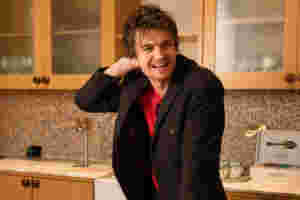
“I’ve lived out of a suitcase for three, four years,” he affirms, shrugging from across the mahogany table between us. “I don’t really have a home, honestly.” A self-confessed nomad, well-used to bouncing between hotel rooms; we shouldn’t be surprised, really, when he nonchalantly begins today’s shoot with a spot of ironing in our Shepherd’s Bush suite. It’s after an hour spent darting between lifts, locales, and traffic lights, joking conspiratorially about jaywalking before doing exactly that (the result of which, dear reader, is this issue’s cover), that we eventually settle down to chat. “Right,” Joe exhales, “now for the good bit.”
It’s an unexpected statement, perhaps - particularly for a man who’s entirely au fait with the gaze of a camera lens - but it’s also one which speaks of an artist who is far from just going through the motions; though he’s unfailingly friendly at every turn, when Joe speaks about music, he’s effusive. Is it, we hazard, just nice to talk about something that’s not related to Hawkins, Indiana? “Yeah, certainly,” he says with a small smile. “And something that I created - it’s fun to talk about something like that. I’ve been working on it for two years, and it’s finally coming out.”
He’s not the only one anticipating the arrival of the “something” in question, either. His third album under the moniker Djo (the ‘d’ is silent), ‘The Crux’ is - aptly - the culmination of years spent juggling musical pursuits with a burgeoning acting career and exponentially increasing public attention. Having amicably stepped away from his former band - Chicago psych-rock outfit Post Animal - in 2019, Joe released his debut solo album, ‘Twenty Twenty’, that same year. Fitting recording around bouts of filming, he followed it up with 2022’s ‘DECIDE’ - a synth-led strut of a record which, like its predecessor, was characterised by digitised instrumentation and bedroom production. But it wasn’t until the mysterious powers of TikTok sent ‘End of Beginning’ stratospheric that Djo became a landmark name on the musical map.
“I had some fans who were listening to the music before who were so great,” he says, assessing when he realised something had shifted. “But there’s a threshold with the internet - at a certain point you can’t really tell how many people are actually involved in this thing. So the real moment [of consciousness] was playing live and seeing 50,000 people from across the world sing this song. That was really the moment where I went ‘oh, okay’,” he pauses and furrows his brow, acting bemused, “‘a lot of people know this song, huh? It’s not just something you did for yourself anymore’.”
And, with the hugely-anticipated grand finale of Stranger Things due to air in the autumn, 2025 is shaping up to be a pivotal year. Essentially, Joe has never had quite this many eyes on his next move.


Ostensibly a break-up record, ‘The Crux’ was born of a period when, both professionally and personally, the ground was shifting seismically beneath him. “Crux literally means cross, so it [represents] that crossing point, you know?” he says, considering how the album’s loose concept - an eponymous hotel in which stays are temporary and people are transient - helped clarify or contextualise its tracks. “It definitely wasn’t something that I was thinking from the outset, [but] it felt like… a good way to root the story of my own personal life. A big theme of the album is [the idea that] I am one of many. The POV is from me, but represented within are all these different characters who are also passing through.”
And when you’ve got either foot in two different worlds - and the gravity of each is getting ever stronger - how do you keep your balance? For Joe, the answer lies in going back to his roots. By leaning into notions of nostalgia, reflection, and community - both thematically and sonically - he transforms what could have been a straightforward heartbreak album into an expansive examination of identity and growth.
“That’s something that was unplanned, but also something that I’m most proud of about this record,” he says, “that it does, more than anything I’ve worked on musically, feel like a journey. It feels like it starts one way and really ends another - it ends with a little bit more hope, and a little bit more peace.” He’s not wrong: a capital-A album in the traditional, structural sense, ‘The Crux’ encodes a notable tonal shift from side A to B, wherein the Strokes-esque sulk of opener ‘Lonesome Is A State Of Mind’ or the bite of earworm singles ‘Basic Being Basic’ and ‘Delete Ya’ give way to the uncynical open-heartedness of ‘Golden Line’ or ‘Back On You’.
The turning point, then, is ‘Egg’ - a contemplative, existential track which lands almost like a poem, an internal monologue that explores “letting fear dominate your decision making, and trying to avoid that.” (“I seem cavalier / But it’s all an act / I’m cold ‘cause I’m weak / And deep down inside / There’s nothing unique”). “I feel like whenever you exit a serious relationship, you always kinda want to go back to your touchstones: who am I without this person? What is it that really makes me, me?” Joe asks. Invariably, the answers to both these questions can always be found at home - not necessarily in a particular place, but with particular people. “That’s probably why I’ve got such [an] attachment to my family, and to my friends from the past,” he says simply. “You’re always trying to root yourself a little bit.”
Less simple, though, is reaching out for these life-rings when the current is pulling you ever-further from familiar shores. “I think it’s just about effort,” he says, considering the difficulty of maintaining friendships into adulthood, when even the closest of bonds can be frayed by frantic schedules or diverging circumstances. “Kind of through heartbreak,” he offers, seeming slightly reluctant to use the word, “you realise that you can self-isolate so easily, or you can be lazy, or you can take it easy too much. But if you put that effort in, I think you’ll get something back.”
It’s a philosophy that’s realised in earnest across ‘The Crux’. Joe’s Stranger Things co-star Charlie Heaton, for example, figures as somewhat of a recurring character on the album (a guest at the hotel, say), his name a byword for uncomplicated, unwavering friendship. “Team up with Charlie / Take these kids for a ride,” he smiles, quoting from ‘Delete Ya’ (a lyric which he assures us isn’t a reference to the show, despite enthusiastic fan speculation). He’s even credited on the record (as ‘groundskeeper’), providing a voicenote-style interlude for technicolour Beatles pastiche ‘Charlie’s Garden’ - a track which pays loving homage to the tranquility of its real-life titular retreat. “That song was written at his house on his piano,” Joe smiles, reminiscing. “We were neighbours in Atlanta when we were shooting, and I’d just go over, and he’d always be doing chores in his yard. It’s memorialising this time last summer - I can close my eyes and picture it.
“It’s for me, really… and for him too! And for the whole crew down in Atlanta. He’s just a really close friend of mine, and I feel like this past year we’ve got even closer. I think I got caught up before, sonically, with sometimes trying to make things sound cool, and now I’m just interested - at least for this album - in using [songs] like a scrapbook, so that when I look back, there’s some real emotion attached to these things. And there really is.”
And Heaton’s isn’t the only familiar name to crop up, either: Joe explains that “all the guys from Post Animal were in town” when they laid down stirring closer ‘Crux’, so he “got to stand at the control room board, watching everyone in the room screaming those vocals”. (“Get back to your heart / Only if you give it back again”).
His younger twin sisters, meanwhile, lend their voices to “a bunch of tracks”, contributing to the gang vocals that envelop Joe’s lead on everything from rousing glam-rock romp ‘Link’ to soaring ballad ‘Golden Line’, supporting him over the album’s course in a tangible sonic sense as much as an abstract emotional one. In private conversation, his love for them is palpable. In practice, it’s now a matter of public record: “‘Back On You’ is a direct message; it’s me being so blunt about the way I feel about my sisters, and the influence they’ve had on me,” he says earnestly, referencing the album’s joyous, heart-on-sleeve penultimate track. “They’ve always been there for me - [siblings] know you like nobody else, and they’ve seen you in every phase of your life. There’s no greater thing I could sing about in my life right now than them.”
He smiles: “It’s cool to have a bunch of people that I know and love on these songs that are basically about loving them, memorialised forever, for me. So that when I put [the album] on when I’m old, it will take me back. Selfishly, it’s kind of all for me.”
It’s in this way that, curiously, ‘The Crux’ manages to be a breakup record that somehow isn’t really about the person in question at all. Instead, it’s an album that’s preoccupied with love in all its forms - romantic, yes, but also platonic, familial, and of the self. The conclusion implied by ‘Crux’’s heartening nine-strong chorus, then, is that often, the great loves of our lives aren’t our partners at all.
“It’s an important lesson to learn,” Joe nods. “I think everybody’s been in a relationship romantically where you’re so passionately in love, that perhaps other relationships in your life fall by the wayside. And in order to have balance in your life - in order to have real stability - it can’t be about just one person, for anyone. And I guess it’s just taken me a little bit longer to get to that realisation.”


Standing in striking contrast to the relative insularity of ‘Twenty Twenty’ and ‘DECIDE’, his third album finds Joe both reaching out and reaching back, throwing open Electric Lady Studios’ iconic doors to old friends and family while also taking musical cues from his formative years.
“I had mostly just made music at home on my computer, so I was really inspired by properly recording analogue instruments in a studio,” he explains. “I had new access to this great new resource, so I wanted to emulate the records that were inspiring to me when I was growing up, to kinda pay homage to those albums by fully utilising the studio.” It’s a fine balance between making something referential and straying too far into the realm of mimicry, though - how did he go about walking that particular tightrope?
“You’re always dancing around that, I think,” he says, “that worry that you’re ringing the bell too hard. But you’ve kinda just got to follow your instinct. And I’ve sort of begun to care less and less about whether people hear the influences. Everybody’s inspired by everybody, and you’ve just got to trust that you’re the cheesecloth all these things are going through, and it becomes this sort of soup…
Both the inquisitive child and the adult muso within him, you sense, were in their absolute element during recording. “What would 14 year-old me like?” he enthuses. “AC/DC, T.Rex, the classic glammy-rock is what I loved. ‘Gap Tooth Smile’ is a song I feel like I almost wrote for myself as a young guy - I think I would’ve been proud of that one.
“Me and my friend Ted were talking recently,” he continues, “about how there are only a certain number of bands in your life where you hear their music and just think ‘I’ve gotta be part of that’. Like: ‘I wanna be in this band, but I also just wanna be part of the audience’. But it only happens a few times; you don’t get a lot of them.” For Joe, there are a few members of this most exclusive of clubs - namely The Strokes and Tame Impala. “‘When ‘Lonerism’ came out, I was right in the crosshairs,” he recalls. “The concept of that record just really spoke to me as a young man; I really related to his experience and just saw myself in him.”
One name, though, crops up more than any other. “Throughout his career, there are things Paul McCartney has done where [it feels like] it’s made for me,” he nods. “When you can see yourself in different forms of art… I know that’s what I’m looking for, that’s what hooks me into different bands.” He pauses, searching for the perfect example. “‘The Long And Winding Road’ by The Beatles. Even just talking about it right now churns something deep within me. That is a love song, but it’s a very specific thing about love that he’s singing about, and it applies so deeply to the way I feel about multiple people in my life. That is a beautiful sentiment: [the idea that] through everything that will happen in our lives, I’ll always come back to you.”

If ‘End of Beginning’ is anything to go by, then, to many people, Djo himself is the architect of similar such “churning”. Take even a cursory glance through his Instagram profile or YouTube comments, and you’ll find myriad instances of people marvelling at how aptly a song epitomises a specific feeling or time in their lives. “It’s hard to feel sometimes that what you’re doing is helping anyone…” he admits. “In the acting world, sometimes I think ‘is what I’m doing really good for the world? Is it making a difference? Is it actually just not good?’” Or, we counter, art functions something like group therapy; it shows people they’re not the only ones. “It is like group therapy!” he agrees. “And isn’t that sort of the point of being an artist? To publicly expel [your demons] so people can feel like they’re represented, so they can see themselves in something.”
If Netflix notoriety and global streaming success brought Joe Keery recognition for two very specific snapshots of his work, then ‘The Crux’ is a fully-realised, three-dimensional portrait of the artist; an artist who, despite everything, is content to just take things one step at a time. “Pop culture and the internet wants to boil things down to a single-note [concept], for anyone,” he says. “And so I have signed over to the fact that a bunch of people will probably just know me as ‘that guy from Stranger Things’ forever. And that’s kind of OK; that’s sort of what I’ve done to myself.
“And also, who cares? At the end of the day, that’s just one part of my life. And I’m really focussed on trying to enjoy the fact that I’m able to do it. You can think about happiness as this big thing that you need to have in your life, or you can think about it as this small goal that you try to achieve every day. Simple things: having a really nice meal with a friend, going to the park, listening to music, making music, being a part of a team, working on a film. Trying to do more of those on a small scale will globally add up to happiness, I guess.”
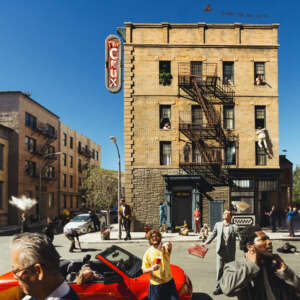
The Suite Life: Joe gives us an insight into the inspirations and BTS happenings of 'The Crux''s characterful album cover.
On its many points of intrigue:
“I worked on this job in Italy with this amazing director called Saverio Costanzo, and he showed me a lot of Italian films I hadn’t seen; in these films, they pose a lot of questions, but don’t necessarily answer them all, and in American culture we really want to tie things up in a neat little bow and explain everything. So I wanted to kind of throw the ball up in the air, and then let other people catch it.”
On its cinematic stimuli:
“We shot it in LA - one of the inspirations was [1954 Alfred Hitchcock film] Rear Window, just kind of Old Hollywood. There’s this great still image where he’s looking out from his bedroom window, and you can see into the building across, all the different rooms.”
On doing all his own stunts:
“We were on this crane with a platform, and I had to wear this harness that was attached to something inside. So it was basically like getting a wedgie for 35 minutes, and just hanging from this window. You know: ‘make it look like you’re struggling!’ The reason there are no shoes in the picture is because the shoes I was wearing were slides, and they just sort of fell off.”
‘The Crux’ is out now via AWAL.
Photographer's assistant: Karolina Malyan


As featured in the April 2025 issue of DIY, out now.

More like this
All Points East adds Djo to lineup for Lorde headline day
Sienna Spiro, Erin LeCount, and Erika De Casier have also been confirmed to play in Victoria Park this summer.
5th February 2026
Djo drops surprise album ‘The Crux Deluxe’
Not content with releasing one LP this year, Joe Keery has now shared its 12-track companion project.
15th September 2025
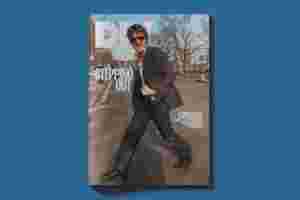
Djo is the cover star of DIY’s April 2025 issue!
Our latest edition also features chats with Lucy Dacus, Sunflower Bean, Black Country, New Road and loads more.
8th April 2025
Djo - The Crux
4-5 Stars
An ambitious, joyous, heartfelt collection.
2nd April 2025

Featuring Yard Act, Death Cab For Cutie, Graham Coxon, Maisie Peters and more.