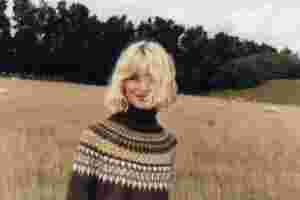
Maisie Peters: Seasons Change
After a series of high profile support slots and live shows around the effervescent pop of last LP ‘The Good Witch’, Maisie Peters found herself ready for a gear change. With her third album ‘Florescence’, she’s dug a little deeper and found contentment in the more intimate moments of life.

“There’s a lot of anxiety in happiness,” Maisie Peters observes. Sitting in a studio in 30-degree heat on one of the hottest days of the year, she takes a break from signing thousands of personalised copies of her newly-released third album, ‘Florescence’. Much like listening to her lyrics, talking to her feels like reading a diary entry. She’s not afraid of her emotions – what she did, how it made her feel – but alongside this, there’s also a remarkable sense of distance between her and the words coming out of her mouth. “Being so grounded in the present [gives] me the ability to look backwards and have a fresh perspective.”
Maisie’s 2023 album, ‘The Good Witch’, left her with a lot to reckon with. ‘Lost the Breakup’ and ‘Body Better’ played on every radio station, and for a while, she seemed to be opening for everyone: Taylor Swift, Ed Sheeran, Noah Kahan, Coldplay – the list goes on. Even the album itself ended with large-scale reflections. Its closing track, ‘History of Man’, encapsulates the simultaneous beauty and “never-ending disappointment” of being a woman: it was big in its ambitions and epic in its delivery. The natural question, then, was what to do next. The answer turned out not to lie in more disco balls and dancefloors, but in their opposite. “History of Man’ feels very big in terms of what it’s saying,” she reflects. ‘Audrey Hepburn’, one of ‘Florescence’’s two lead singles, is the complete opposite: “It feels very little, very intimate.” The shift between these two songs, in miniature, is the shift between the two albums.
In the same way, the answer to “where next” ended up lying in Nashville, the home of country music, where, for the first time in a while, she allowed stillness to take over her life. It was a conscious decision: “Spending a couple of years touring and playing those really big pop songs and these big pop shows made me want to dip my toe into the other side of what I do.” That other side, of course, is the acoustic singer-songwriter style of the early EPs, where she first made her mark. “Making big, outrageous fun pop songs can come from a place of chaos, which I love,” she elaborates, “but the stillness of where I was at with this album created something that felt much more grounded.” Nashville made her “softer and more gentle,” she says. “It was the most grounded I’d ever been, and the happiest.”
That’s precisely where the album’s title stemmed from - florescence: the slow process of coming into bloom. “It happen[ed] incrementally and subconsciously, and it’s hard to pinpoint exactly when and what that change was,” she says, “but it was sort of a transformative time.” That quiet confidence bleeds into almost every track, chronicling what she calls the “road to happy”. “‘Florescence’ was never going to be this super happy and love-filled album, and that’s not the way I wanted to document that happiness. I wanted to delve into what it took to get there,” she reflects. No emotion, she’s eager to note, is ever entirely what it seems: “there are always so many caveats to it.” If anything, happiness is harder to write about than the sadness or heartbreak she’d confronted in her music before.
The happiness on ‘Florescence’, then, is not bold or bright or in-your-face happiness. It’s understated satisfaction, stemming, in large part, from growing up. “I don’t know if I’ll ever feel like this worldly adult; I don’t know if anyone does. I definitely feel more confident and more aware… I gain a little bit more of that with every day that passes.” In practice, this means hoping a past lover is doing well on ‘Say My Name in Your Sleep’; it’s accepting that past relationships ending on ‘Nothing Like Being in Love’ was for the better; and it’s finding the beauty in the mundane on ‘Audrey Hepburn’ - cups of coffee in bed, the quiet of the countryside, and the realisation that sometimes the best things are kept private.
There’s no better place to look for what this happiness is, exactly, than the album’s opening track, ‘Mary Janes’. Through her previous albums, the opening track is a mise-en-scène, a welcome, a reflection on where she was when she wrote the record. Not coincidentally, ‘Florescence’ opens with her listing her insecurities before blossoming into the chorus: “Oh, I’m not the coolest or the greatest in the club / It doesn’t matter, oh man, anymore, who gives a fuck? / When I’m in love”. There’s still acknowledgement of her flaws or insecurities, but they come with a sizable, love-shaped ‘but’. “These things, these insecurities, that keep me up at night feel so fickle in contrast with this love that feels so important,” she says. “A lot of your insecurities can’t really hold their ground against a love like that, it’s too powerful.” It doesn’t even have to be romantic love, she is quick to add. But love, above all else, is the “blanket of confidence and strength” that’s brought her to where she is today.
At its core, this complexity is precisely what ‘Florescence’ is all about. While ‘Audrey Hepburn’ was announced as the lead single, she simultaneously surprise-released ‘You You You’ – one hopeful, one sad; two sides of the same coin presented at once, signalling from the start that the album would resist simple categorisation. “I liked giving people those two sides so they knew the album was going to be full of those multitudes,” she says. “It’s not what you think it’s going to be.”
Alongside her insecurities, humour also earns its place in her musings on love. The music video for ‘My Regards’ stars Benito Skinner and is directed by Amelia Dimoldenberg, and pays tribute to cult classic The Bodyguard, while wit peppers one-liners throughout the album: “A bookshelf full of women that you won’t read if you’re honest / A desk that’s worth more than the words you wrote on it” (‘Houses’); “But sometimes the wine that you drink is better off down your dress or the sink” (‘You Then Me Now’). The best bits, though, are more hidden. “The moments no one else really sees are all the moments you remember the most,” she says, citing making a TikTok on the beach in Bournemouth in the freezing cold; the album shoot at her parents’ house; and the gleeful chaos of a two-shows-a-day acoustic tour.


It’s fitting that the album’s most daring moment is also its most solitary. She’s no stranger to writing alone, having worked on her craft since she was twelve. ‘Houses’, however, is the first one written entirely by herself to make it onto a record. “Something about writing alone is very concentrated – it’s the most undiluted version of my perspective,” she says. It also illustrates something about her approach to songwriting more broadly. “Primarily, I’m thinking about myself and if I love the thing that I’m writing. I try not to have a lot of other cognitive thoughts apart from [thinking]: ‘what I am saying, how I am saying it, is this the best way I can say it?’ That tends to be the most that a brain can fit.” The result, she says, was “honestly very affirming – to feel like something I make by myself holds as much importance as something I make with others.”
Those others, on ‘Florescence’, come in the form of collaborators Marcus Mumford, featured on ‘If You Let Me’, and Julia Michaels, on ‘Kingmaker’ – two collaborators who pull very different things out of her. Marcus brings out her musicality and pushes her towards bolder sounds, while Julia’s “second to none” lyricism gets the most out of whatever feeling or concept they’re writing about: “she knows exactly the perfect way to tell her story”. It’s a skill Maisie herself has in abundance, which perhaps explains why the collaboration works: they’re two people who, in their own ways, are trying to say the thing exactly right.
The album’s emotional and sonic atmosphere didn’t come from the studio alone. At the beginning of the writing process, Maisie read Rebecca by Daphne du Maurier, and its influence is everywhere once you know to listen for it. The novel’s preoccupation with the British countryside as a site of haunting, the past pressing up against the present, and the feeling of being watched by your own life all worked their way into ‘Florescence’. “The British countryside really acts as a perfect backdrop to that,” she explains. “It’s very wild and beautiful, but it can also be very cold and sparse. I think there’s a lot of really great metaphors to be done with the British countryside.” She grew up in rural Sussex, spent her adult life in London, and after touring ‘The Good Witch’, she found herself back in the place she was made (to reference her own song).
‘Florescence’ is also an album about time. She looks back at past relationships with fresh eyes, documents the present, and gestures towards a future she can’t name yet. “Whatever I’m doing in ten years’ time, I hope it’s something that makes me happy, or if not, I hope I’m getting some good songs out of it,” she jokes. But for the moment, she compares it to time-travelling: “Most writers are able to hold the past and present and the future in different hands and go between them at will.”
Unsurprisingly, she’s no stranger to writing, or indeed books, informing her work – the power dynamics in Hilary Mantel’s ‘Wolf Hall’ partially inspired ‘Kingmaker’ – and as a way to promote the album, she did a set of UK performances in bookshops and florists. As for any future books that may make their way into her songs, she pulls up her Goodreads. “Oh my goodness, I need to think about what I’ve read. I read a lot!” The answer comes in the form of Lena Dunham’s memoir on fame in the 2010s, Famesick, and Chloe Michelle Howarth’s Heap Earth Upon It - also set, as it happens, in the countryside. Both, it’s safe to say, have since been added to DIY’s reading list.
The album ends exactly where it needs to, with the lines: “And you were nothing like being in love / With somebody honest, somebody kind, somebody always by my side / There’s nothing like being in love”. “That, to me, is really the thesis statement of [‘Florescence’],” she says simply. “I write so much about love, I find it so inspiring and so interesting. That line encapsulates the album, encapsulates me, the way that I work, and the music that I make.”
Maisie’s final reflections on ‘Florescence’ might still be some time away, though. “I love writing as an analysis and as a conclusive paragraph on relationships or times in your life,” she shares. “I find it hard to conclude when I’m in the present.” For now, a summer of writing awaits, fuelled, in part, by the release itself: “You’re back in touch with the version of you that wrote those songs,” she says, “and that can, for me, act as a catalyst to [say]: what should I make now?” After that, more touring and a landmark show at the O2 are on the horizon. “I’ll have to see what creatively moves me. I don’t know what it will be yet.” She says it without any apparent anxiety - which, after ‘Florescence’, might be the most telling thing of all.
‘Florescence’ is out now via Gingerbread Man Records / Asylum Records.
Read More

Kelela: Fear The Future
Having become renowned as one of music’s most cutting-edge but fluid visionaries for well over a decade, on her dystopia-fuelled third album ‘new avatar’, Kelela is both returning to her roots, and looking firmly ahead.

Yard Act: The Perfect Antidote
They’ve burned the Rover and built their own studio - three albums deep, Yard Act aren’t resting on their laurels. Now returning from LA with a new record in tow, James Smith and Ryan Needham talk to DIY about self-awareness, finding their sound, and just why we all need a little music right now.

Wolf Alice: Park Life
One of their generation’s greatest indie success stories, with latest album ‘The Clearing’ Wolf Alice have well and truly conquered the big leagues while always staying true to their roots. Returning to North London this summer for the fullest of full-circle moments, the band are rounding out their victory lap the only place possible - with a hometown turn at Finsbury Park playing their biggest ever headline show.

Thundercat: Claws Out
On his new album ‘Distracted’, Thundercat - the acclaimed bassist, sought-after collaborator, and cultural iconoclast - is joined by Tame Impala, Mac Miller and A$AP Rocky as he takes on the social media age. It’s a complicated portrait of an artist facing up to a strange time in his life - and an even stranger time in the world at large.