
Cover Feature Yard Act: The Perfect Antidote
They’ve burned the Rover and built their own studio - three albums deep, Yard Act aren’t resting on their laurels. Now returning from LA with a new record in tow, James Smith and Ryan Needham talk to DIY about self-awareness, finding their sound, and just why we all need a little music right now.
On the opening track of their impending third album, Yard Act’s James Smith delivers a droll aside to the listener: “By now you’re either with us or you’re not / So you can sit down, shut up and listen / Or switch this shit off.” To be fair, he’s got a point.
The last five years have seen Yard Act carve out an instantly recognisable place in British indie canon. Both more humorous and tuneful than many of their post-punk peers, they’re undoubtedly a homegrown success story. That being said, across new album ‘You’re Gonna Need A Little Music’, the band perform an escape act from the Yard Act that the average listener might have a mental image of. Along a journey that took them from Leeds to Los Angeles, they have shed their preoccupations of suburbia and English malaise, widening their sound on an album that they see as a “jumping-off point”. It’s easy to imagine the record winning over those not already with them.
That journey, though, begins with a slightly more mundane thrill - that of finally having a space of their own. “It’s like a clubhouse, essentially,” grins James. He’s describing the studio that the band have built for themselves in Leeds, all the while sipping an Aperol spritz alongside his bandmate, bassist Ryan Needham. Casually bickering in the way only old friends can, they’re fondly remembering the beginning of the writing process, which seems to revolve around the studio - specifically, the band being left alone there.
“It’s kind of an extension of us,” nods James, “and it sort of doubles up as a [Yard Act] museum as well. You collect a lot of interesting things along the way, doing this job. There’s gifts from Japanese fans…” “Like a flag!” Ryan chips in, before James picks back up. “Things that people give you that you don’t necessarily want in your own house because you don’t want to look at yourself constantly,” he laughs, “but you want somewhere to keep it, because it’s of worth to you. It’s a reflection of the time you’ve put into it, I suppose.” In conversation, he’s almost exactly as you’d hope from the version heard on record - immensely quick-witted, and unable to resist undercutting anything remotely sentimental with a dry aside.
Away from souvenirs from their travels, the studio is of course Yard Act’s place of work, too - “a place where you don’t feel like you’re on the clock”, according to the frontman. It’s a sentiment the band took to heart when writing the album, spending five months holed up here. “To be left alone, that was always my dream!” James laughs. “It was the first time since we began touring that we could stop and think straight. Let ideas come to fruition organically and over time. Experiment. Try things and just drop them on the cutting room floor without any pressure.”
They both light up when recalling sketching out the new songs - a time that James describes as “the most fun I’ve had since the band began.” Ryan nods: “It was quite a relief that it worked, because we’d never worked that way before, it was always little snapshots of time in people’s houses. We spent all this time and money building the studio - the first time we plugged in and sat around, it was quite daunting: ‘what if it doesn’t work like this?’”


From the sound of the finished record, they needn’t have worried. ‘You’re Gonna Need A Little Music’ is a sprawling version of the smart, tightly-structured indie the band are known for. All their hallmarks are still present - from James’ theatrical delivery to Sam Shipstone’s wiry guitar lines and Jay Russell’s agile timekeeping - but it also feels like a much grander version of themselves. Take closing track ‘Over The Barrel’: beginning with what could easily be a lost Strokes B-side, it then collapses into sludgy stoner rock before finally falling into a Beach Boys-esque harmony-driven flourish. There’s nu-metal guitar scratching on ‘Thrill Of The Chase’, and plaintive balladry on ‘Janey Said’. And still, it all sounds just like Yard Act and nobody else.
From their period of studio solitude, the band seized on a further widening of their ambitions, courtesy of American producer Justin Meldal-Johnsen. A collaborator to acts including Paramore, Wolf Alice, Beck, and St Vincent, he’s very much the man that you turn to when you want to fill a grander canvas - a brief that he immediately lived up to. “Justin said, ‘I want to do 12 weeks’,” recalls James. “We said, ‘we’ve never done more than two weeks on a record, this is insane!’ We compromised on nine - five weeks in Leeds, four in LA.”
Five months writing and another two recording - was it a daunting prospect for a band used to fitting in sessions in any spare time between shows? “That length of time was quite stressful for my overactive mind at the start, because I didn’t know how you fill it,” says James. “I realised you fill it with reflection, essentially. It turned out to be the right thing for it, and it meant that all the ideas could gestate and grow.”
The two halves of the recording schedule found the band in markedly different climates, too. “We built the fundamental structure of it in Leeds,” explains Ryan, “and then when we went to LA in the sunshine, we played around more.” “Leeds winter, LA winter…” grins James. “LA winter’s very different!” “It was less suffering artist, more suffering producer when Justin came to Leeds,” recalls Ryan. “He was the only one who suffered.”
“Yeah, we made Justin suffer for our art. But he secretly loved it, because he loves the first wave of goth music, and he was in the spiritual birthplace of goth, so he was getting off on that,” says James. “But I could tell that he couldn’t handle the lack of sunshine, despite the fact he wanted to be a part of the misery.”
Meldal-Johnsen’s impact in the studio began long before a microphone was even switched on, with him joining the band for two weeks prior to recording, “playing the songs through and then analysing them, working them out before we even hit record,” explains James. “What was great about Justin was he’s a studio whiz, but he’s also got skills as a player and as a musical director, because of his work with Beck. So he understands arrangement in a way that sort of transcends the studio.”
On record, a good arrangement is a hard quality to define, other than a feeling that the songs just work, all the parts pulling together effectively into a unified whole. “I feel like he did the groundwork, in terms of how the songs work live,” nods James. “This album’s been so much easier to learn - it’s a lot more organic sounding because of Justin, helping us sculpt the arrangements so that everything flows without extra studio tricks.” Ryan grins: “Doing bigger and more, with less going on.”
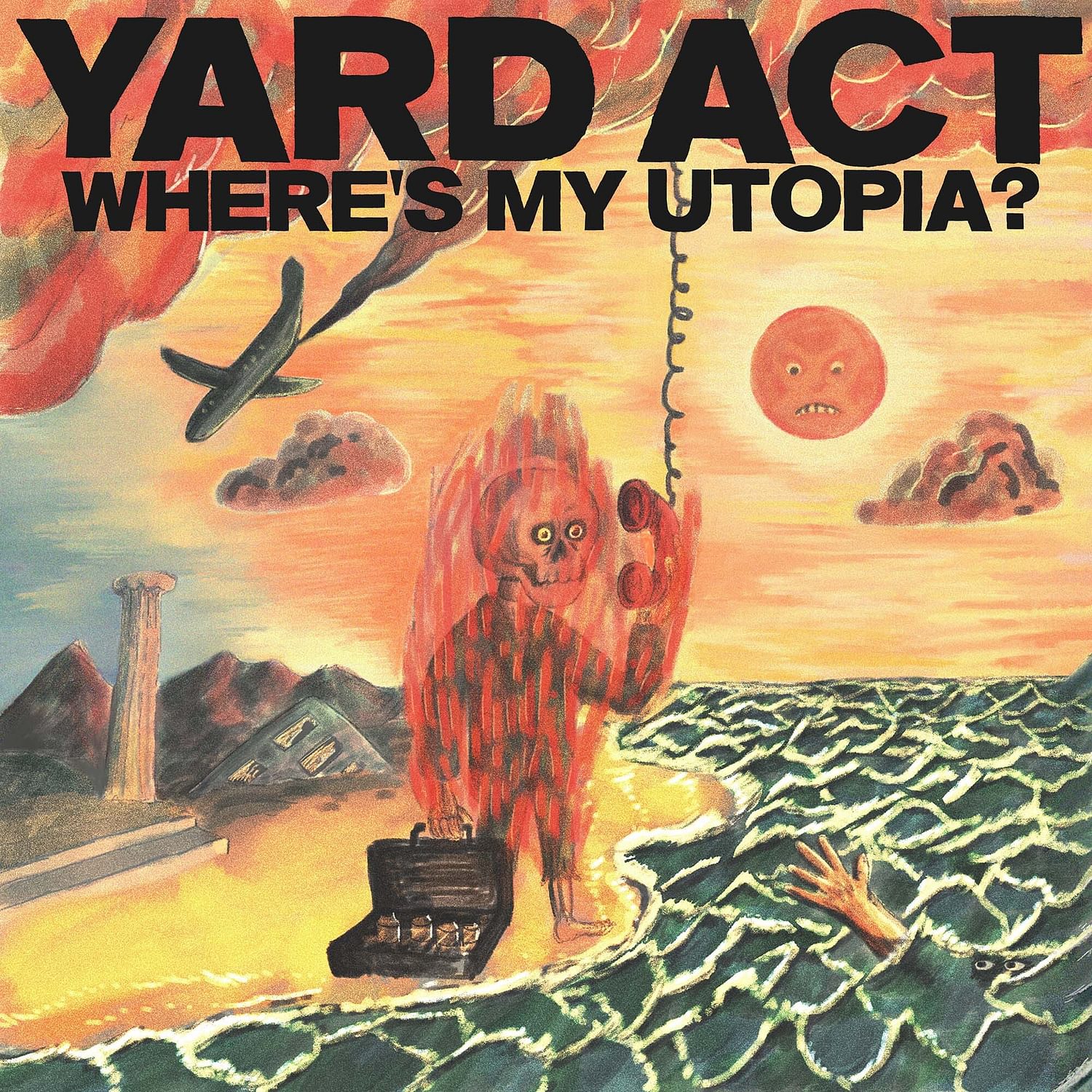
There’s another sense here too, though - not just of songs that are well-produced and constructed, but that are a product of a band who’ve spent enough time on the road to feel like a well-oiled machine. “The craft of the songs on it is way stronger than anything we’ve done before,” thinks James. “There’s no defined time on how long it takes for a band to completely find their own sound, but I think the better you get at your craft, the easier it is to assimilate wide-ranging influences into what cohesively makes it sound like ‘you’. I feel like the second album [2024’s ‘Where’s My Utopia?’] cast the net really wide in terms of influences, but it was still very much an homage to those influences. This time, I do feel it always sounds like us.”
It’s a slippery target, though, attaining a trademark sound. Once there, the logical next step is that audiences are attracted to - or avoid - the music with preconceptions. Did the average listener’s idea of what a ‘Yard Act album’ should sound like feature at all while writing? After all, they’ve always been a band with an acute - and very witty - awareness of how they’re being perceived.
“It’s something that I’ve been working on letting go of since day one, I think,” says James, after a pause. “Self-awareness has always been a bit of a calling card, but it has its limits. I think there’s the last dregs of me being like that on this record. This is the transitional record for letting go of that, and fully embracing the fact that the music is more important than we are. I don’t feel the need to have me in it to sell it any more, it can go its own way, and do its own thing.”
And which way is that? “The only way it can go is to become more impressionistic and vague,” he reasons. “There are less answers, it’s less defined, there’s less explanation for it. Ultimately, people can take their own meaning from it, and it can exist for longer, because it’s not been cracked, if that makes sense? You can crack the code of a song like ‘Fixer Upper’ very easily, but what are you left with after that? With this, I think you’ve got to make your own answers.” He pauses and laughs. “Got to make your own questions, as well.”
It’s a convincing argument - and one worth testing. The album’s title, ‘You’re Gonna Need A Little Music’ - is it advice to the listener? To the band themselves? Or something else? “There are quite a few meanings to that title,” says James, coyly. “One of the angles Ryan always thought was quite funny was that it sounds quite threatening, that we were shoving it down people’s throats.” “It could be a cure,” adds Ryan.
“But ultimately, a little music feels like not much,” says James. “But it’s not, it’s a lot to a lot of people, including myself. A little music goes a long way, and it can carry you, it can get you through tough times. The ‘gonna’ implies that there’s something worse coming, you know what I mean? We live in a constant state of anxiety, where imminent threat is always on the horizon. So to know that there’s already something in our artillery that will help us beat that, I think that’s kind of sweet, you know?”


It’s classic Yard Act optimism: a band who don’t shy away from life’s big questions, but always tackle them with a twinkle in their eye. As James explains, the record is preoccupied with individualism, and our lack of “a shared reality”. It’s a subject he’s been mining for some time; take the Little Englander mentality of Graham, the narrator of their breakout 2020 single, ‘Fixer Upper’. “In the Western world, since Thatcher and Reagan, we’ve been hurtling towards the culmination of neoliberalism - the mindset that we are the most important thing, and our beliefs are right. This applies to the left as well as the right: everyone feels entitled to this right, and the second you’re unmalleable in your thoughts, you’re only headed towards a place of solitary isolation. Ultimately, the record really taps into that, the inherent selfishness of everyone.”
James is sanguine about being culpable of this himself, too. “Our brains have the ability, as seemingly intelligent creatures, to justify our actions if it’s to serve what we believe is a greater purpose,” he continues. “Even if it’s a selfish act, to get ahead - like me getting on an aeroplane, it’s an inherently selfish act. Everything is connected, and it all contributes to somebody else’s suffering somewhere down the line, whether I can see it or not. I think the record does try and grapple with whether we’re ready to accept that, for all the good in the world, we’re not one or the other, and that until we’re ready to accept our own selfishness, we’re not ready to advance beyond the state we’re in.”
And yet, among this clear-eyed portrayal of late-stage capitalism, there remains the uniquely Yard Act kernel of optimism. It’s become almost a calling card of theirs, ending a record with a reminder that among all the strife, people are at their essence, okay. ‘The Overload’’s ‘100% Endurance’ and ‘Where’s My Utopia?’’s ‘A Vineyard For The North’ both fall firmly into this category, as does this LP’s closer ‘Over The Barrel’, with its repeated insistence to the listener to “break through … I want you to break through”.
What, then, keeps him from feeling nihilistic, among all the depressing truths of life in 2026? “Well,” he says with a smile, “I think there’s a lot of fun to be had in life.” He pauses to think. “I think it’s a given now that we all come from different levels of privilege. The more your basic needs are taken care of, the easier it is to give yourself to beauty, and the positives in the world. I know that I’m in a better position than most, to be able to give myself time to find those, but ultimately it can be found. There’s loads of amazing stuff. Even this is nice! The entire history of the universe, of civilisation, it’s not one thing. It’s not fucked, and it’s not brilliant, and a lot of it you can find if you remain open. I get it from people! Humans are fucking funny, life’s okay - and one day, if it’s not, either there’s something beyond, and that’s exciting, or that’s the end, and that’s peace. I do think we’re a more inherently selfish species than we like to think we are. But that doesn’t mean that we’re doomed.”
It’s a very Yard Act conclusion to reach. And, in true James fashion, almost immediately he dismisses the thought, moving on to talk about a documentary he’s seen about aliens hiding in the ocean. That’s where DIY leaves them, with Ryan and James bickering about whereabouts in the ocean aliens might hide, over their luminous beverages. Times are grim, and they may be getting grimmer, but Yard Act can be relied on to chronicle them - always with tongue firmly pressed in cheek.
‘You’re Gonna Need A Little Music’ is out 17th July via Island.
Records, etc at


Yard Act - Dark Days EP

Yard Act - The Overload Black Friday 2022

Yard Act - The Trenchcoat Museum

Yard Act - You're Gonna Need A Little Music

Yard Act - Where's My Utopia?

Yard Act - The Overload
As featured in the June 2026 issue of DIY, out now.

More like this

Yard Act offer up new single ‘New Beginnings’
Our current cover stars have shared a second taste of their forthcoming third LP, ‘You’re Gonna Need A Little Music’.
24th June 2026

Yard Act are the cover stars of DIY’s June 2026 issue!
Our latest print mag also features chats with Graham Coxon, Death Cab For Cutie, Maisie Peters, BIG SPECIAL and loads more.
10th June 2026

Yard Act announce third album ‘You’re Gonna Need A Little Music’
The Leeds quartet will follow up their 2024 record ‘Where’s My Utopia?’ this July.
8th May 2026

Yard Act announce live return with November 2026 UK shows
The Yorkshire lads will be back in action in Leeds, Manchester, and London later this year.
24th March 2026

Featuring Yard Act, Death Cab For Cutie, Graham Coxon, Maisie Peters and more.