
Interview Death Cab For Cutie: Skylines And Turnstiles
In the wake of the indie-rock veterans’ eleventh record, Death Cab For Cutie bandleader Ben Gibbard talks ‘I Built You A Tower’, compartmentalising his life, and why a new generation of fans inspires him to be more transparent.
“You guys don’t have skyscrapers the way we do in America,” notes Ben Gibbard, admitting he struggles to orient himself in the sprawling city of London while stating the obvious. One marker on his geographical radar, however, is Dishoom. Before meeting DIY, the Death Cab For Cutie main man made his debut visit to the renowned Indian restaurant chain, impressed by its “fucking explosion of flavours”. Much like the status Mexican cuisine enjoys back home in the United States, he reckons the quality of Indian food in the UK is second to only India itself.
We know multiple versions of Ben Gibbard, but none feel second-best. As frontman of Death Cab and The Postal Service, whose one-and-done 2003 album ‘Give Up’ remains a cult classic, as well as 2012 solo effort ‘Former Lives’, he has long been a beloved figure. After some of the noughties’ most seminal indie records in ‘Transatlanticism’ (2003) and ‘Plans’ (2005), two further decades of experimentation in Death Cab have now led the band to their 11th album. Titled ‘I Built You A Tower’, it suggests there’s plenty more chat about skyscrapers still to come.
On the adjacent sofa at Strongroom Studios, the man who runs ultramarathons when he’s not writing music looks incredible for his age; he turns 50 this August. On this London visit, he jogged down the canal into Victoria Park, the festival site of All Points East, which both of his bands co-headlined in 2024 to belatedly mark the 20th anniversaries of ‘Give Up’ and ‘Transatlanticism’. After wrapping up those celebrations, what appeared like a quiet 2025 saw Death Cab support My Chemical Romance at their hometown stadium show in New Jersey.
“I had more people reaching out for tickets for that show than probably anything we’ve been involved with,” Ben jokes. “They’re a band that I had been obviously aware of for a long time, but I didn’t really know their music that well. You see [them live] and just get it: ‘Oh, I 100% understand what people love.’ They spare no expense for presenting that record,” he says, referring to their iconic 2006 album ‘The Black Parade’.
Released when Death Cab were penning sombre acoustic cuts like ‘Soul Meets Body’, any chance of the two bands joining forces would’ve likely been unthinkable back then. “We were so far up our own asses, promoting ‘Plans’, we were in our own world,” remembers Ben. “But it’s been really fascinating to see what has stuck with people. I’m not insinuating that I wouldn’t have assumed My Chemical Romance would, but [it was a] time where kingmakers were telling you that The Rapture were going to be the biggest band in the world. And then they weren’t…”
One who could reasonably claim that trophy, however, is Dua Lipa, whose tour swung by Ben’s hometown of Seattle in October. She invited him to duet ‘I Will Follow You Into The Dark’, rivalling MCR for another item that was certainly absent from anyone’s 2025 Ben Gibbard bingo card. “At soundcheck, she was the most wonderful, kind, radiant person I’ve ever met,” he smiles. “It’s a top-down situation in her camp; everybody is the same way… and so I left that show [as] a fan. I’m ride or die for Dua Lipa!”
“I’d find myself [on the ‘Transatlanticism’ tour] asking, ‘Why don’t I write songs like this anymore?’”
— Ben Gibbard
Among these cameos and celebrations came ‘I Built You A Tower’. Abandoning the drum machines and placeholder demos that characterised recent records, the process was instead driven by the “interwoven interplay” between treating bass, guitar and his own drumming as three hooks in themselves: the same combination that underpinned ‘Transatlanticism’, he explains: “I’d find myself [on the tour] asking, ‘Why don’t I write songs like this anymore?’”
That analogy demonstrates the inevitability that any conversation with Ben Gibbard will circle back to the 2000s. He accepts that many will ground Death Cab in that era, the same way that the fan inside him contextualises The Cure’s ‘Disintegration’ or Superchunk’s ‘Foolish’ against formative memories. It means that reliving his own 26-year-old self - and playing songs from ‘Transatlanticism’ - is not a burden nor an unwanted time machine, but a truth that can coexist with his attempts to become a better songwriter as the band evolves.
“I’ve been having this reckoning with what I love about the band,” he says. “When an artist has a long career, you can see peaks and valleys, but [fans are] like, ‘well, I really hope they circle back around and find a thread of the thing that made us all love them in the first place.’ My hope is that this record, and whatever we make moving forward, can have elements that people like, but an emotional maturity indicative of a person my age. The difficult balance of a career artist is to recognise what you’re good at, while also trying to push forward.”
Looking to Neil Young’s ‘Harvest Moon’ and Metallica’s latest output as the blueprints to follow, ‘I Built You A Tower’ is Ben’s first attempt at that synthesis. ‘How Heavenly A State’ unifies his signature vocal register with the choppy post-punk you’d find on Paramore’s ‘This Is Why’, while the melancholy synth-pop of ‘Trap Door’ sounds like The Postal Service reworking the mood of ‘Plans’. Lead single ‘Riptides’ is a ticket back to 2003, fraught with the panicked urgency of someone faced with “too many riptides in this ocean to proceed”.


“It’s really loss that’s the real teacher, not victory… that’s where the real growth happens.”
— Ben Gibbard
Each song could represent its own tower. More widely, they act as an exercise in separating every chapter of Ben’s life; a means to move forward while also acknowledging their existence through a symbol of permanence. Leading up to this album, one tower staring Ben in the face was the end of his second marriage.
“There’s a skyline of your life, almost like an aerial shot of New York City,” he explains. “They’re all different heights and sizes, and every building is connected to a period in your life, person or memory. Going through a divorce… not only the end of something, which is painful, but also, all the things that were wonderful in that ten years we were together get put into this larger edifice. When you look at this emotional horizon, you see all of these structures and know what’s in there, but you don’t have to constantly interface with it.
“Three years ago, I was going off stage and talking to lawyers, dealing with the emotional and logistical elements of separation, and then also going on stage at Madison Square Garden, like, ‘Hi guys!’, feeling as if I had to put that whole chapter of my life in this edifice and lock the door to do my job. We have to compartmentalise a lot of pain or trauma in our lives just to get through our days. If you’re a parent and you have kids, you have to set that aside and take care of your children… show up for people in your life. But sometimes, when you least expect it, the doors of those buildings blow open and overwhelm you.”
Away from that double life on the road, we ask Ben if his relatively dormant 2025 meant he was overwhelmed by what he had to confront. Without the pressing responsibility of turning up for both his audience and bandmates, alone time and therapy meant the aftermath of his divorce ended up becoming a considered period. “I wasn’t angry or bitter,” he says, demonstrating the same calm temperament and grace with which he treats all of our inquiries today.
“For the first time in my life, falling out of a relationship, I really wanted to do the internal work,” he continues. “Sometimes, the easiest thing is to just blame the other person. We’ve all had that friend who broke up with somebody, and you start to notice a pattern that everybody they date is crazy. Actually, I think you have a lot of work to do on yourself.
“Sometimes we forget that we are an active participant in our own lives, not the victims of someone’s malfeasance,” he continues. “It’s [about] recognising [that], ‘this is not the outcome I was hoping for, but I still consider that time of my life valuable.’ Some people might feel [that] ‘I wasted this period of my life, because it didn’t turn out the way I wanted it to.’ I’ve really broken free of that idea. I’m paraphrasing Leonard Cohen, but it’s really loss that’s the real teacher, not victory… that’s where the real growth happens.”
“The reality of losing people is that you carry those people with you.”
— Ben Gibbard
Ben would likely not be here speaking today if he hadn’t passed a mental checkpoint that means he’s ready to gear up for the responsibilities that come with releasing and promoting an album. Describing this work as “another deadbolt in the door” of that tower, one wonders if the man who sings “I’m trying to hold it together” in ‘Stone Over Water’ is still feeling that way.
“As a Gen X, you see this [joke] crop up on social media: ‘People today, they just talk about their feelings!’” he begins. “We’re living in this wrought time where we’re starting to look around and [question], ‘are we cool with this?’ The most obvious example is the current administration in my country. What is AI going to do to our lives? We’re looking at each other going, ‘I’m having a tough time - are you having a tough time?’
“It’s starting to permeate and break through the ‘keep calm and carry on’ [mindset]. It’s something younger generations are bringing to the world that is really valuable. I was feeling a little bit sheepish about singing this stuff originally, because I do come from this generation of [thinking], ‘we don’t talk about this stuff.’ But I started to really find myself leaning into the fact that a lot more people are feeling this way than are admitting it. Friends of mine are specifically pointing out ‘Stone Over Water’: ‘That’s the thing that hit me like a ton of bricks’.”
For a songwriter with Ben’s candour to unlock new phases of transparency, this far down the line, is a respectable feat in itself. If 2015’s ‘Kintsugi’ was about making peace with his past, ‘I Built You A Tower’ recycles that idea through a framework that guides him through his present-day predicament, and hopefully, whatever obstacles come next.
“I’ve secured this time of my life, I feel comfortable leaving it where it is,” he ponders. “The reality of losing people is that you carry those people with you. This horizon of buildings that different people live in has become really meaningful to me, because I can go and visit them whenever I want. They’re not going anywhere. Even people who I would prefer to never see again were in my life for a reason. I learned something from them, and hopefully they learned something from me.”
‘I Built You A Tower’ is out now via ANTI-.
Records, etc at


As featured in the June 2026 issue of DIY, out now.

More like this
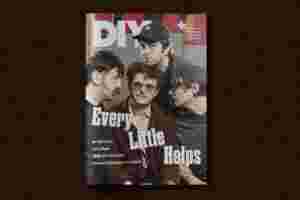
Yard Act are the cover stars of DIY’s June 2026 issue!
Our latest print mag also features chats with Graham Coxon, Death Cab For Cutie, Maisie Peters, BIG SPECIAL and loads more.
10th June 2026
Death Cab For Cutie - I Built You A Tower
4-5 Stars
Punchier and more immediate than much of what has come before.
5th June 2026
Death Cab For Cutie offer up new single ‘Punching the Flowers’
The track gets lifted from the Washington quintet’s forthcoming 11th album, ‘I Built You A Tower’.
28th April 2026

The Postal Service and Death Cab For Cutie top an alt-rock dream bill for All Points East’s final day
Ever since the lineup was announced, it always promised to be indie rock Christmas for a certain demographic.
2nd September 2024

Featuring Yard Act, Death Cab For Cutie, Graham Coxon, Maisie Peters and more.