
Interview Dry Cleaning: Behind Closed Doors
A band who have always felt that little bit indefinable, upon the release of their third album ‘Secret Love’, Dry Cleaning talk us through building their own world, cryptic lyrics, and the simple joys of making music with close friends.
If you could hear them out loud, what might your thoughts sound like? Your inner monologue, the cluttered movements of your brain? Dry Cleaning’s music often seems like an attempt to answer that question, to bring the listener into the interior world we all live in. Part of the flush of innovative guitar bands that suddenly came to the fore in the late 2010s, the quartet have always felt slightly uncategorisable: part art project, part garage jam band, but above all else alluring and oddly moving. And it’s exactly this spirit that they’ve seemed to capture on their third album, ‘Secret Love’.
Despite being released within the first few days of 2026, this third full-length actually had a prolonged gestation period, in comparison to previous efforts by the band. “Our other two records, we’d recorded almost in semi-lockdown,” explains vocalist Florence Shaw today, a week on from the album’s release. “It’s hard to remember now, it feels like another life, but I think we just wanted to remedy that as extremely as we possibly could. To go out into the world as much as we could, and to collaborate as much as we could.” As such, the band visited a web of places and people they’d come across during their time touring the globe, and began to sketch out new material, spending time with Gilla Band in Dublin, and at Wilco’s studio, The Loft, in Chicago.
What began to emerge was a subtle evolution of their magpie-like approach to indie music; the soft guitars of Yo La Tengo rub up alongside the drone and thrash of Sonic Youth, and both are added to by sounds entirely of the group’s own making, strange and fleetingly beautiful textures that are really quite hard to label. (At various points in the conversation they reference bass clarinets, giant frogs, and Zelda soundtracks as touchstones.)
The unifying thread as ever with Dry Cleaning are Shaw’s often spoken, occasionally sung, lyrics. Over the course of the album, she relays to us tales of cruise ship designers, childhood desires, food obsessions and secret, aching, love. She does this via lyrics ranging from the mundane to the bizarre. “I find cleaning demeaning,” is a typical Shaw line; so is “alien offshoot mushroom, going to the gym to get slim”.
When the time came to finally corral their demos into a record, the band looked for someone to produce the album. Previous albums ‘New Long Leg’ and ‘Stumpwork’ were recorded with the same producer, John Parish, and the group felt it was time to be pushed in a new direction - bringing them to the door of Cate Le Bon.

“I think we’re ambiguous in every sense. There’s a clash of genres, and then a new thing emerges.”
A musician in her own right, Cate felt a natural choice. Her own work treads a similarly fine line between considered dissonance and quiet beauty as Dry Cleaning’s does, and her production credits include contemporaries such as John Grant and Horsegirl. “Very warm, and very funny,” is how Florence describes Le Bon. “She also leaves a lot of space. She doesn’t fill silence, which is a really confident position to take, and which I found immediately really impressive.”
In the summer of 2025 the band decamped to Black Box Studios, in rural France, to begin recording with Cate. “It was idyllic, it was in the middle of nowhere,” recalls Lewis Maynard, the band’s bassist. “Every morning we’d wake up and I’d go for a little bike ride, the others would go for a little run, and it was a very cliche, picturesque, beautiful little French town. There are zero distractions, you become so close as a unit - you all sync up humour-wise, and influence-wise. You’re not really listening to other music, or any external influences for two or three weeks. You go a bit crazy, but in a good way.”
Maynard also points out the importance of living and working all in the same place. “When we were demoing and going to different studios, one thing we realised we didn’t enjoy is commuting an hour to a studio. It resets anything you’ve achieved the previous day as a unit, you seem to forget it and everyone comes in with a different kind of energy or a different vibe. So a residential studio is really good for that, especially one so isolated.” He also thinks the band’s downtime together with Le Bon was just as important as the long days spent recording. “You can have a more stressful day the next day, but because you’ve had this time all together in the evening, it helps the daytime as well, and it really feeds into each other.”
Soon, they began to establish a routine, with Cate and engineer Samur Khouja pushing the band to record in a structured way. “Cate and Samur introduced this idea of making improvised drone-esque music for 20 minutes at the start of every day,” recalls Florence. “They would set up the studio so that they were ready to record this improvised stuff that we would make. We’ve got all those recordings, we need to go through them, but that was really fruitful actually, and really fun.”
Le Bon’s creative approach to recording also extended to feedback she would give the band, with critiques in the vein of Brian Eno’s Oblique Strategies. “The kind of thing she would say would be ‘think of shadows on a wall’,” explains guitarist Tom Dowse. “As part of the jams that Flo was describing, I came up with this shimmering guitar sound that didn’t involve me playing the guitar at all, just sort of holding it, bending it - I was trying to perform it, trying to get it where I wanted it to go, and that’s when she said, ‘think of it as shadows on a wall’. She’s really good at balancing technical aspects with more abstract elements of making music. In a band like ours, half of which are trained musicians, half aren’t, you do have to ride that line. She really understood that.”
“The band has encouraged us all to be more ourselves, rather than to meet in the middle.”
— Florence Shaw
The product of the band’s time in the studio is an album of contrasts - at times delicate, and at times muscular. “I think we’re ambiguous in every sense,” says Shaw. “There’s a clash of genres, and then a new thing emerges. There’s also a clash of images as well, that don’t necessarily complement each other. I think lots of people can be a bit frustrated by that sometimes. They think that we’re being wilfully difficult or something - especially live, people get upset,” she laughs. “The band has encouraged us all to be more ourselves, rather than to meet in the middle. It’s not necessarily a really easy to digest package, but I do think it’s interesting to just present different things on the same plate, and say, ‘there you go!’”
Shaw’s lyrics are, in some senses, hard to analyse - at times it feels like she’s writing in character, at others it’s as if she’s playing a word-association game. “I suppose it’s different ways to answer the same question, of ‘what does a vocal add to this?’” she considers. “Because it has to be something. If I feel like I’m just amplifying something that’s already there, I don’t feel very motivated to do that. I only ever really feel motivated to twist something slightly, or add a layer that might not be complementary. Sometimes that’s a person, a character who’s talking, and sometimes it’s me, it brings something from inside of me out. And sometimes it’s about being playful and imagining some absurd, barely two-dimensional person to do the talking or the singing.”
While the album’s lyrics can seem like a constellation of disparate thoughts and feelings, Shaw says that there are “a number of themes on the record” that are only now emerging to her. The gap between her conscious thought and her subconscious preoccupations seems to be a very important part of her process. “I try to just get as direct a line as possible from brain to lyrics. I really try not to overthink it actually, which I think is partly responsible for the weird structure of the lyrics sometimes, because I’m trying not to mess with the order that ideas come up in. If I do return to the same thing, I just allow that to happen.”
What threads, then, does Shaw see as tying together the tracks on ‘Secret Love’? “There are lots of things about complicity in different forms on the record,” she says, pausing to think. “‘Cruise Ship Designer’ is a little like that, but also ‘Blood’. Chemicals in the body come up a few times as well, which almost feels like it could be a metaphor about some type of complicity.” It’s fascinating hearing a writer analysing their lyrics as if someone else has written them. “There’s lots of romantic sentiment, but private romantic sentiments, unspoken things, hidden things, concealment. They’re intentional, but not necessarily at the forefront of my thinking. They reveal themselves to me over time.”


“There’s lots of romantic sentiment [on the album], but private romantic sentiments, unspoken things, hidden things, concealment.”
— Florence Shaw
It’s easy, when describing Dry Cleaning’s music, to make the band sound overly serious - like a conceptual experiment taken to its natural conclusion. The reality, though, couldn’t be further from the truth; the four members of the band are warm, witty company, and clearly deeply in love with the act of making music together. “We’ve built up a lot of trust over the years,” says Lewis, “so you can explore. It’s not strange for Tom to come to rehearsal without a guitar and just a keyboard, or Flo to be playing harmonica rather than singing. The playfulness comes from that, because no one’s ever going to shut you down for trying something. It’s not saying that everything works, but there’s a playful attitude in the room of ‘just try everything.’”
For a few years now, the band have hosted a radio show together, on the cult internet station NTS. Taking it in turns to bring records to the table, it’s perhaps here that it’s easiest to see both the deep bonds that the four have. “It’s actually really helpful to have that every month,” Tom explains, “because literally we take it in turns, and to some extent, you’re trying to complement what you’ve just heard, but also change it a little bit, because we’re all working from four different record collections, it’s almost like jamming. We’re also really grateful to NTS for letting us have a show, it’s not a thing you get offered lightly.”
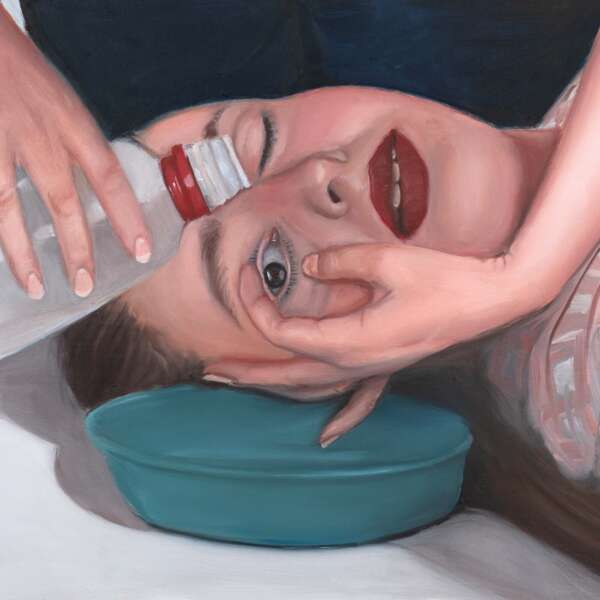
Having originally met at art college, it’s unsurprising that Dry Cleaning’s records have always had a striking visual component. ‘Secret Love’ is no different, this time with a painting by Erica Eyres gracing the cover. “We’re very closely involved with all of the artwork,” Shaw nods. “We spend lots of time talking about them and making sure they’re just right. But also it’s a really nice opportunity to collaborate with people, an excuse to meet great artists, and hear about their process.” Maynard agrees: “It’s the final twist, isn’t it? In the same way that if Tom comes with a guitar riff, I put a bassline to it, it slightly twists it, Nick puts a drumbeat to it, there’s Flo’s lyrics which twist it again, and the same with the title. The final twist is the artwork, and it will change the meaning one more time, potentially.”
It seems as succinct an explanation of Dry Cleaning’s appeal as any: twists layered upon twists, a band never knowingly missing an opportunity to layer hidden facets into their work. ‘Secret Love’ feels a perfect title for the band - yes, at first glance obtuse, but beneath there lies a world of strange and wonderful things. It may be hard to describe, but that’s the joy of it.
‘Secret Love’ is out now via 4AD.
Records, etc at

As featured in the February 2026 issue of DIY, out now.

More like this

Magdalena Bay are the cover stars of DIY’s February 2026 issue!
Our latest mag also features Dry Cleaning, hemlocke springs, Antony Szmierek, Demob Happy and much more.
6th February 2026

Dry Cleaning - Secret Love
4 Stars
It’s not a record likely to shift anyone’s needle, but for those on the fonder side, it’s a whole new set of treats to explore.
7th January 2026

Dry Cleaning strive for optimism on ‘Secret Love’ closer ‘Joy’
The London outfit’s third album lands this Friday.
6th January 2026

Dry Cleaning share new single ‘Let Me Grow and You’ll See The Fruit’
It’s the band’s third cut to be lifted from their forthcoming third album ‘Secret Love’.
10th December 2025

Featuring Finn Wolfhard, FLO, Jungle, Mystery Jets and more.