Interview Kneecap: From The Rutz to the Rabble
Government battles. Tabloid outrage. Conservative outcry. In their short time in the spotlight, Kneecap have whipped up their fair share of it all. Pranksters or heroic political rebels? The Irish trio are equally a bit of both. And on ‘Fine Art’, they’re painting hip hop a new shade of green, white and orange.
‘FREE PALESTINE YOU FENIAN C*NTS’ reads the yellow slogan spray-painted onto the façade of Molly Bloom’s this evening. The unassuming Irish pub on Dalston’s Kingsland Road is hosting the release party for one of the year’s most talked-about debut albums, and if the profane graffiti isn’t an implicit enough indication that you’ve reached your destination, the gargantuan queue snaking around the pub and down a nearby alley easily substantiates the intel.
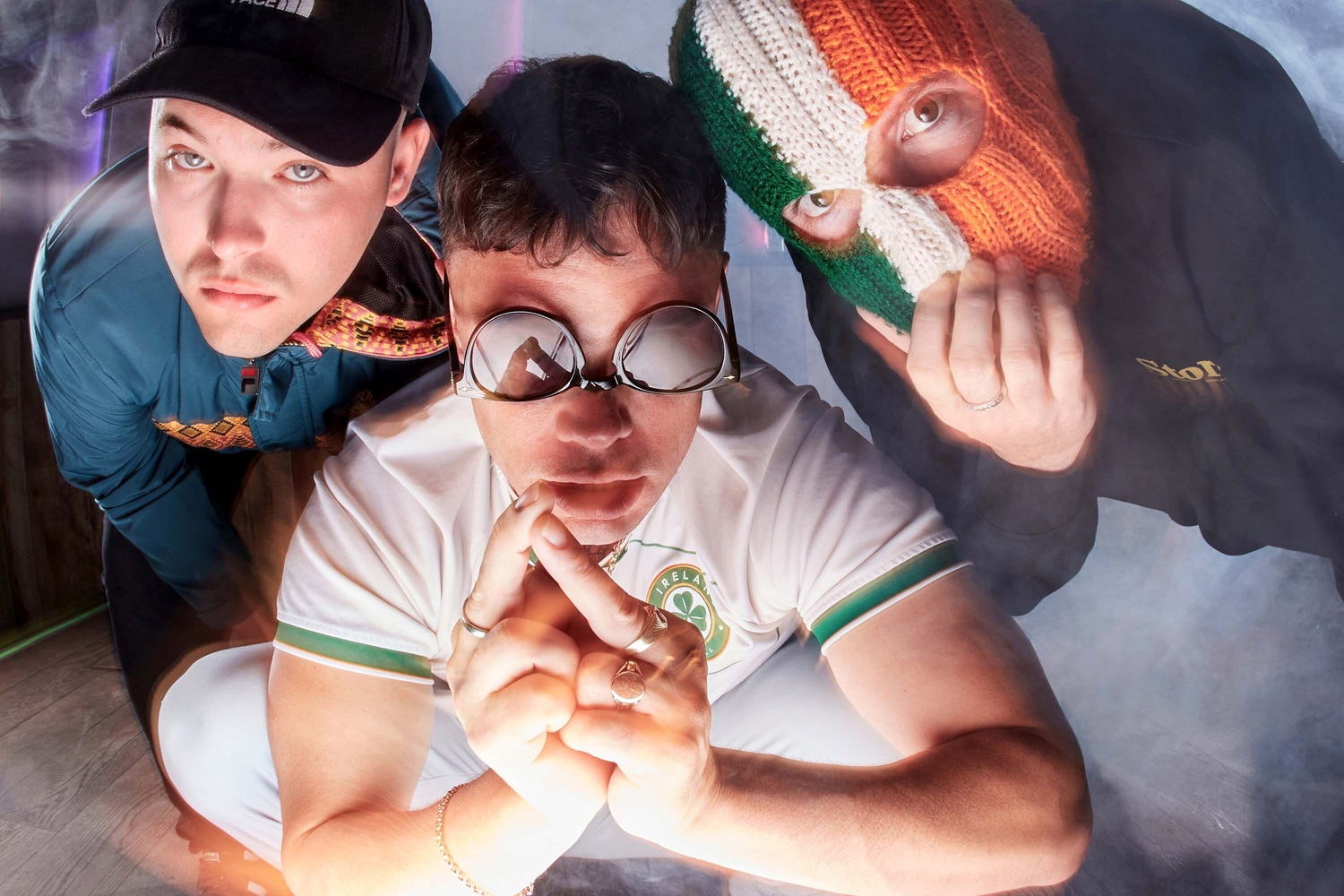
Renamed The Rutz for the occasion, the traditional boozer has been transformed into a living, breathing lookbook of ‘Fine Art’: the inaugural LP from Belfast trio Kneecap. Every inch of the ceiling that isn’t taken up with Irish paraphernalia is adorned with the Palestinian flag. Aged regulars from the Emerald Isle are sat at tables, grinning as the trendies of London’s music scene clamber shoulder to shoulder on the sweaty, makeshift dancefloor, and a blow-up sex doll that looks suspiciously like the King is passed around overhead like a festival crowdsurfer. Backed by the genre-hopping heft of ‘Fine Art’ blasting through the PA system and the malty scent of Guinness being poured at a rate of knots, the tavern conveys its brief with the utmost commitment to the bit.
Brought to life for one night only, this pub has existed in the minds of Móglaí Bap, Mo Chara and DJ Próvaí for some time now. Kneecap invented The Rutz as a conceptual home in which to set their debut album when they stepped into the studio with producer Toddla T in the summer of 2023. “That was my idea,” Chara interjects. “Naw, it was definitely mine,” responds Bap, wagging his finger. It’s the week prior to Kneecap’s hijacking of Molly Bloom’s and the three members are gathered in a bar booth a few miles more central. “When we met Toddla he was like, ‘Do you wanna do a collection of songs or do you wanna do a concept album which ties together cohesively?’” Chara continues. “And that option sounded like way better craic.”
The Rutz may not be the most lofty of album concepts, but it’s a tight one. Far from the theatrical grandeur of lunar casinos or blind pinball prodigies, The Rutz is art imitating life – or rather, lifestyle. Just as it is for a portion of working class society, the pub is a core component of the trio’s existence and – in symmetry with the content of ‘Fine Art’ itself – a sanctuary where obscenity, depravity and, crucially, humour exist under one roof. “The pub was the perfect place to set the album,” Bap explains. “‘Cause it can be the best place in the world or the worst place in the world, sometimes on the same day.”
“The pubs where we’re from aren’t like the ones you have here,” Chara notes, name-dropping The Duke of York – an establishment across the way from their London hotel that keeps a sizable picture of Prince Andrew on display. “It’s not even hung there ironically!” Bap protests. “Who the fuck are the people drinking in there? Are you not embarrassed?!”


“Hip hop is a storytelling genre. It’s the ideal medium for oppressed communities.” – DJ Próvaí
The most valuable contribution of The Rutz is in the way it provides a framework for everything else Kneecap pull together across their debut. Real radio newscasts discussing the trio’s controversial stunts play in the background of album interludes and, throughout, you can hear pints being poured as traditional Irish musicians play just within earshot. The 13-second ‘State Of Ya’, meanwhile, dialogues a patron who denies taking coke in the toilets despite the evidence being smeared over his face. The attention to scene-setting detail throughout the LP is bolstered by Kneecap’s resolve to rap in their native language, creating a tricolour brand of hip hop which stays true to the genre’s identity without betraying the geographical setting from which ‘Fine Art’ was born.
“If you go back even ten years ago in Ireland, a lot of people doing hip hop were using American accents and talking about gang-banging – things that weren’t ostensibly Irish,” says Chara. “We wanted our own authentic take, talking about things which are intrinsically Irish and making it our own: celebrating our culture and our history.” “You don’t wanna just copy another genre and shit on it, because there’s context there,” Bap continues. The pair speak in a back-and-forth patter which mirrors Kneecap’s live performances, dovetailing one another’s points and sharing ideas in an almost telepathic flow. “We wanted to use hip hop to look introspectively, while showing respect to the genre.”
Prior to Kneecap’s inception, Irish-speaking rap was all but nonexistent. “Hip hop in Ireland was all Americanisms,” recounts Chara. “Then The Rubberbandits came along with lyrics that weren’t so braggadocious. They’d have tracks about why it’s superior to own a horse than a car; it’s comical and it’s Irish. Their songs would be ridiculous, but they were so clever and they backed it up well.” The Rubberbandits’ influence is notable, but touchstones from just about every hip hop-adjacent genre over the past four decades have left fingerprints on ‘Fine Art’. The antagonistic frat-rap of Beastie Boys and Dead Prez’s lyrical back and forth are both present throughout Kneecap’s output, delivered on a bed of breakbeat and glossed with a sheen of traditional Irish folk. Flashes of Jamie T’s hooky, abrasive delivery also make themselves heard on tracks like ‘I’m Flush’, with the group even covering his enduring hit ‘Sheila’ for the BBC’s Live Lounge the day before we sit down.
“Hip hop is a storytelling genre,” Próvaí says. “You can talk about what’s happening around you in the present moment – socially or otherwise – and that’s why it’s the ideal medium for oppressed communities.” Unlike his chatty bandmates, Próvaí remains quietly attentive throughout, chiming in with an authoritative tone on a quality-over-quantity basis. He was a music and Irish language teacher in a secondary school before joining Kneecap. A sliding doors moment for the group saw him fired from his school by a panel of nuns who, upon his dismissal, presented Próvaí with a video of himself snorting white powder on stage and exposing the words BRITS OUT on his bare buttocks. Early attempts to lead this double life saw the DJ hiding his face with a balaclava in the colours of the Irish flag; his identity slipped eventually, but the on-stage aesthetic survived.
This early furore was to set the tone for a long line of controversies, from commissioning a mural of a burning police Land Rover in West Belfast, to promoting their tour with a cartoon of then-DUP leader Arlene Foster strapped to a rocket on top of a bonfire alongside Boris Johnson. RTÉ, Ireland’s publicly owned broadcast company, pulled the group’s first single ‘C.E.A.R.T.A’ (Irish for ‘rights’) from the airwaves, sparking a mass petition from fans and handing Kneecap far more publicity than a spin of the track might have offered. “We’re on the radio flat-out now,” Bap laughs, before Chara continues: “It reached a point where they didn’t have a fucking choice!”
Earlier this year, taking umbrage with their outspoken stance against British occupation in the north of Ireland, a Tory MP vetoed a financial grant which was initially awarded to help fund the band’s American tour, inadvertently adding more fuel to the group’s publicity fire in the process. “£15,000 probably wouldn’t even do us that much good, it’s not that much money when you’re touring America,” Chara shrugs. “But now that it’s escalated into a court case, it’s become a national news story and given us publicity that money can’t buy.” The week after we speak, the band are granted High Court permission to formally take action, with a full hearing into claims of discrimination on grounds of nationality and political opinion set to take place in November. With legal proceedings still ongoing, Kneecap are limited to what they can say on the topic, but they’re prepared for an Erin Brockovich-style showdown.
“We’re not controversial strictly for the sake of it – we’re well-read and well-spoken.” – Móglaí Bap
Not content with riling up their detractors via one medium, the band have also turned their story into a feature-length film. Having already scooped an Audience Award at New York’s prestigious Sundance Film Festival, the premiere saw the three band members arrive atop an armoured police van, holding green, white and orange flares aloft. Equipped with a few months of weekly acting lessons and working against both financial and time restraints, the resulting self-titled biopic makes for the most unlikely of instant classics. Written and directed by Rich Peppiatt, and featuring Michael Fassbender as Chara’s father, even the band themselves took some convincing that the project had legs.
“It took months of Rich chasing us,” Chara recalls. “We ignored him for ages. We were like, ‘Who the fuck is this fella? He’s full of shite!’” Encouraged by Fassbender’s seal of approval, Kneecap worked alongside Peppiatt, feeding the script with anecdotes and memories. “You’re treading a fine line when doing a film like this,” Bap says. “It can be cheesy, portraying drugs or the working class on screen.” “We had full say in things, which was great,” Chara continues. “I knew from reading the script that it could be fucking good, obviously Fassbender isn’t going into a film that doesn’t have a decent script.”
Wrapped in just seven weeks, the crew would make up to 110 scene resets in a single day, as the ever-diminishing reserves of money dwindled and time ticked on. “You really depend on the good will of the crew hanging back to get days finished, and the quality of the food on set was getting worse and worse as the money ran out,” Bap recalls before Chara quips: “Then Fassbender arrives on set and the caterers up their game…” It might seem like a jump from stage to screen, but the trio are quick to point out the natural thread. “Our live gigs are already an exaggerated version of ourselves, so we’ve essentially been acting for ages,” Chara reasons as a barman delivers him a fresh pint. “We’re drawing on our own experiences and we mean what we say, but at the end of the day it’s a fucking show.” “It’s a fucking show!” Bap mimics, theatrically.
The plaudits garnered by the film – the first Irish-dialogue entry in Sundance’s history – mark the latest stride of many for the language’s visibility. We’re in the middle of a rapid growth period for the oppressed language and it’s a movement that Kneecap witnessed first-hand before playing a significant role of their own. Belfast’s first Irish language school, which both Chara and Bap attended as adolescents, opened in 1991 with a total of nine pupils; today, there are 8,000 pupils in IME (Irish-medium education) across Northern Ireland. “There was a lot of shame around [speaking] Irish previously. It was the language of poverty,” Próvaí says. “Going back a hundred years, there was a thing called the ’bata scóir’ in schools: students would wear a string around their necks and each time they spoke Irish, a wee notch would be made on the string and each notch would result in a beating at the end of the day. Our language was literally beaten out of use as a form of cultural oppression.”
Although a step in the right direction, teaching Irish in schools isn’t enough to make the language commonplace among a new generation. Slang terminology including drug references and swear words were yet to exist, and a language which can’t articulate the modern world is doomed to remain in the past. “There were words that we’d use between our friends when we were speaking in Irish,” Bap says of the contributions that Kneecap’s lyrics have made to the lexicon. “Words like ‘snaois’ [pronounced ‘sneesh’, meaning cocaine] just kind of stuck, then we realised the importance of including these words in our tunes and making Irish a living language among young people.”
“You know things are heading in the right direction when you’re able to text a dealer in Irish and they respond,” Chara laughs. “Now, you’re hearing tracks sung in Irish about fellas shagging fellas, which is exactly the kind of stuff that the language needs.” “That’s the reality of language,” Bap adds. “And this is the kinda content that kids are going to listen to, whether that’s NWA, Eminem or Megan Thee Stallion.”


“You know things are heading in the right direction when you’re able to text a dealer in Irish and they respond.” – Mo Chara
With the likes of Fontaines DC (“What a band!”) and CMAT (“She’s a legend, she’s killing it”) both making serious statements outside their homeland, and Cork-born actor Cillian Murphy recently picking up an Oscar, Irish culture more broadly is seeing its own global purple patch and there’s a belief within Kneecap that this isn’t merely serendipitous. “There’s a newfound freedom in Irishness nowadays. People who grew up Irish in the ‘80s didn’t have the same confidence in themselves that this generation do,” Próvaí says in
the considered, teacherly tone that has never left him. “There isn’t that fear to put yourself out there and be artistic. Back in the day, this Irish creativity was introspective and written down quietly; that’s why there have always been great Irish authors.”
The trio’s lyrical touchstones of masturbation, plundering dole money and drug-fuelled benders might not be cut from the same literary cloth as Joyce or Beckett, but that’s the point. Kneecap are rebels with a cause: their subject matter riles up the nation’s conservative Catholic population in the same way that their calls for a united Ireland piss off the loyalist, Protestant community, forcing both sides to ask questions of themselves.
Despite how outspoken they’ve been on England’s negative contributions to history, however, Kneecap haven’t been surprised to see the British music press swooning over their antagonistic brand of hip hop. “We started getting noticed over here while already having a big enough platform to talk about our politics and our ideas,” Bap reasons. “Which gives people the opportunity to understand us a bit more – we’re not controversial strictly for the sake of it; we’re well-read and well-spoken.” “In our second language, no less!” Próvaí is keen to point out.
With overwhelmingly positive reviews for ‘Fine Art’ coming thick and fast, it isn’t inconceivable that Kneecap could see themselves nominated for a BRIT Award over the coming year; an accolade which would surely be a step too far for the outspoken Irish Republicans. “The fucking irony of that! I wouldn’t be allowed back in West Belfast,” Chara chokes on his pint, laughing at the notion. “Too fucking right we’d attend the ceremony though.” “I’d be up for it,” Próvaí affirms, smiling. “We could melt the award down and turn it into something useful.”
‘Fine Art’ is out now via Heavenly.
Records, etc at


More like this
KNEECAP announce new album ‘FENIAN’ with Keir Starmer takedown ‘Liars Tale’
“This isn’t a swift reaction, but a considered response to those that tried to silence us. And failed.”
28th January 2026
Matt Berninger, Kneecap, ¥ØU$UK€ ¥UK1MAT$U & more join Open’er 2026 lineup
Electronic icon Martin Garrix will also join the bill for this year’s Polish weekender.
26th January 2026

Alexisonfire, Kneecap & Frank Turner make for another stand-out 2000trees
Beautifully inescapable, immeasurably euphoric, and year-on-year the absolute highlight of festival season.
26th July 2025
Wide Awake adds Luvcat, Peaches, Sega Bodega and more to 2025 lineup
KNEECAP, CMAT, and English Teacher top the bill for the Brockwell Park festival’s next instalment.
4th February 2025
Featuring Yard Act, Death Cab For Cutie, Graham Coxon, Maisie Peters and more.