
Interview Kojey Radical: Real Talk
While his debut album saw him garner critical acclaim and award nominations aplenty, for its follow-up ‘Don’t Look Down’, it’s a sense of community, vulnerability and openness that remains the most important focus for Kojey Radical.
Given how much his life has changed in the last few years, it makes sense that Kojey Radical’s second album ‘Don’t Look Down’ opens with a simple grounding exercise. From the get go, the Londoner is at his most introspective as he delivers a pep talk in front of the bathroom mirror. “Don’t look down if you’ve got the world at your feet,” he whispers, “Just breathe.”
Catching up with DIY during a hectic release week, the musician says he’d do well to remind himself of those opening words right now. Having established himself as a bonafide giant of UK rap off the back of his 2022 Mercury Prize-shortlisted debut ‘Reason To Smile’, he explains that leaning further in came naturally when trying to find his most authentic voice.
“I just wanted to tell the truth,” he muses. “With that opening poem I was trying to capture that inner anxiety. It’s a moment of self where I acknowledge that I always give the best advice to other people but never really take it myself.” Very early into the conversation, he attributes dropping those personal barriers to the album’s cast of close collaborators both new and old.
“These are all people I don’t mind feeling vulnerable in front of,” he says. “There was no fear of letting go and saying what I really felt.” It’s perhaps a little surprising, given the album features an extensive list of collaborators, including an array of established UK talent in Ghetts, Bawo and MC Cristale alongside names from further afield like Canadian hip hop trio Planet Giza and Texan rapper Dende.
He says that through creating a nurturing, community-driven environment in the studio, his collaborators were enabled to open up as much as himself. “The album’s topics came from the conversations that we were having when writing. It’s the perspective of the people I’m working with and the things happening in their lives. It was a real community feeling. We’d sit down and eat together three meals a day, there was a real sense of togetherness in being vulnerable.”


“There was no fear of letting go and saying what I really felt.”
A quite brilliant example of this comes with the tender piano-led ‘Baby Boy’, which tackles the brutal challenges of fatherhood. With features from Ghetts and Chrissi, it’s deeply emotive as he raps over gospel backing vocals: “To be everything to you that my dad never was / Is the only thing I ever really want / But wants can lead to nots like why was you not there / Why you not in the house / Why was you so scared?”
“That song came from quite a personal conversation I had with [producer] Owen Cutts about the things that were happening in his life and how they coincided with my life. We just knew that was the song we had to make and we couldn’t skirt around it. I have to give credit to everyone for creating that space and really being there for each other.”
There is, however, respite from these more serious themes. “I like the contrast,” Kojey explains. “We do use music as escapism but music should address what’s happening in real life. I like to lead and end with the idea of hope. Everything isn’t doom and gloom, I think that’s the theme I keep trying to bring back. Through all the troubles, keep dancing, knowing that the revenge will taste much sweeter in the end.”
One of the most impressive things about ‘Don’t Look Down’ is how the album flows as a cyclical story, with collaborators floating in and out. Kojey stresses how these are in place to serve the work as a whole. “Everyone’s writing to keep the story going. I don’t place myself above anyone, I’m at the mercy of everyone who graced this album. To curate and orchestrate the project felt seamless, it was really important to keep everything flowing.”
The ambient background noise throughout the album also helps submerge you into his world. “It’s definitely world-building within a sonic landscape,” he offers. “While I was out gallivanting, [producer] Swindle was hard at work learning TV and film scoring along with soundscaping. That allowed us to put the music in a space in real time, so as you’re listening to it, you’re there and you can imagine where you are. It’s all intentional, this album was made with obsession.”
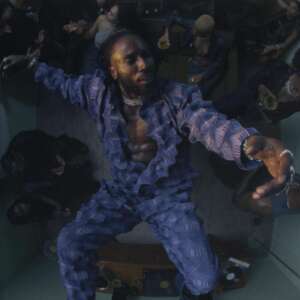
“I like to lead and end with the idea of hope.”
Although ‘Reason To Smile’ put him on the map as a leading force within UK rap, Kojey still felt external pressures weighing down on him heading into ‘Don’t Look Down’. “I made the album through a time when I had been algorithmed out of the game,” he reasons. “You’re having to fight for Instagram and TikTok to even put your music in front of people. It can be demotivating, especially in an age when your whole campaign becomes a big social media push.”
Noticing the stark reality of such industry shifts, he quickly changed his approach and pulled further towards community and connection. “It allowed us to create this foundation and this community behind the album. We got creative and put on events for listeners to come and party with us or play video games and listen to the tracks.” He says he found it way more rewarding than any likes on a social post. “It was beautiful to see because a lot of people that have supported me quite heavily over the years got to see me in a very human light.”
Kojey suggests that his need to dig deep and build his own community comes from being the youngest of a big family. “My siblings were basically adults by the time I reached kidhood. It’s not like you’re by yourself but you get comfortable with this idea of solitude. I find the things I poured into that music created this family and community that I can speak to often. I’ll recognise them at shows and speak to them about their lives.”
He’s also noticed his community growing older across his ten-year career so far. “I’ve been making music for a long time now. The people I was running around Brick Lane with are now figuring out what to do about an engagement or their house renovation.” That passage of time has inevitably bled into his writing. “I can’t make music for the 22 year old me, I’m in my thirties now and I need to make music that feels like now. In order to do that I have to know the audience I’m speaking to and what we deal with day to day.”
As well as sentiments of family and growing up, on tracks like ‘Life Of The Party’, Kojey grapples with the champagne lifestyle that followed his debut album. Over a reclined beat he toils, “I know that good weed, good wine / I’ve been losing my mind / It’s like I know everybody / But I stumble and try.”
“I’ve never seen myself as famous but I was rocketed into whatever that feels like,” he reflects. “You overindulge in all of the things that come with success and it takes you further away from what you know like old friends and family. You look at it and think, ‘if the bubble were to burst, where would I be?’ All of this disappears and you don’t nurture the relationships that you started with and that’s the main theme of the album.”

“I made the album through a time when I had been algorithmed out of the game.”
Having become a household name alongside his status as an innovative force within UK hip hop, Kojey admits he’s felt the goal posts shift in terms of the way people now see him. “I’ve always felt like I’m in a position where I have to do ten times as much for half of the recognition. This is my second UK hip hop and R&B Number 1, but we’re not having that conversation. I’ve got two Number 1s, I’ve got all of these nominations but people don’t really talk about that.”
Switching off from those expectations, he finds solace in everyday comforts. “At a certain point, when I clock off and leave the studio, when I’m not front-facing, I’m a civilian. I play Playstation, go skateboarding and enjoy the fruits of it all. I’m blessed to be able to create for a living. Without me, all of this continues. Music doesn’t stop if I stop, if I don’t have anything to contribute then I might as well just shut my mouth.”
Accordingly, one of Kojey’s main ambitions throughout his journey has been to find universal connection. With the urgent and percussive single ‘Conversation’ landing on the recent EA Sports FC 26 football game soundtrack, it’s clear he’s still excited about having his music reach living rooms around the world. “The audience that brings for me is incredible. I love nothing more than being able to perform to people who otherwise never would have heard my music. Now they’re invited into this space which is good music for everyone.”
He cites Tom Misch as an influence in that overarching reach. “Tom will do a show and look out into the audience and the demographic is everyone from everywhere. The people there just like the music because it sounds fucking good. He was really key in making me realise that you can do that, it’s just about getting the music to where it needs to be.”
When it comes to getting people in rooms, there’s the small detail of an upcoming Royal Albert Hall show on the horizon next summer. Kojey sees the 5,000-capacity show as something he’s been building towards from the off. “I’m ready, that’s all I can say. I’m ready for that show. I feel like I’ve been building up to it forever because of what that venue allows me to do.”
As an innovative force, it’s clear he’s still a man daring to keep pushing his limits. “There are bigger venues and maybe one day, God willing, I’ll be able to do an arena or a palace or whatever. In terms of stages that exist and buildings that exist, with that many people, The Royal Albert Hall is the only one where I can put on this type of show.”
That ambition in the live arena is unsurprising when considering what peers like Ezra Collective and Ghetts did on big stages at Glastonbury this summer. “Ezra Collective are my biggest inspiration and do you know why?” he questions. “It’s because they did it with just music.
“They’ll do a clean, 45-minute set with their guests backstage and by the time you come on the whole building will be jumping, screaming and dancing. It’s just jazz music. It’s possible without the bravado of the frontman.” His next parting cuts to the heart of the humble character that’s felt central in his rise. “It’s not, ‘everyone come and watch me’, it’s ‘everyone come and listen to music’. I’m trying to represent the same thing. If you build it they will come.”
‘Don’t Look Down’ is out now via Asylum Records UK / Warner Music UK.
Records, etc at


As featured in the October 2025 issue of DIY, out now.

More like this

The Last Dinner Party are the cover stars of DIY’s October 2025 issue!
Our latest mag also features Geese, Jay Som, Kojey Radical, Miltarie Gun and loads more.
13th October 2025

Kojey Radical - Don’t Look Down
4 Stars
An artist in total, delightful control of his craft.
19th September 2025
Emmeline joins forces with Kojey Radical to share ‘Dust’
The track also marks the release of her new EP, ‘Small-Town Girls And Soft Summer Nights’.
28th July 2023

“Being shortlisted came as such a surprise” - Kojey Radical talks ‘Reason To Smile’
Ahead of the 2022 Mercury Prize with FREE NOW, we spoke to the multi-hyphenate to reflect on his career-defining album.
28th August 2022

Featuring Yard Act, Death Cab For Cutie, Graham Coxon, Maisie Peters and more.