Interview Melin Melyn: “You have to be creative in order to get people to pay attention”
To mark the release of their fantastical debut album, we sit down with the Welsh cult favourites to talk storytelling, Spice Girls, AI and more.
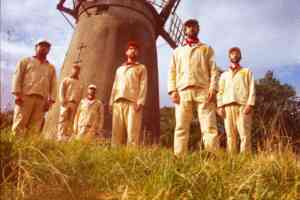
Whether you’re a longtime fan or first time listener, buckle up - Melin Melyn have arrived to take you on a musical ride like no other. Having spent the past few years establishing themselves as one of the most joyous, original bands around, the idiosyncratic Welsh six-piece have finally unveiled their debut full-length, ‘Mill On The Hill’ - a conceptual, kinetic manifesto that takes in everything from surf-pop to prog-rock with gusto. To celebrate its arrival, we catch up with Chief Miller Gruff Glyn (lead vocals, guitar, saxophone) and his trusty right-hand man Garmon Rhys (bass, backing vocals) to be transported to the wonderful world of Melin Village. All aboard…
Hey Melin Melyn, how’s it going? How have you been preparing for the (now pretty imminent!) release of your debut album, ‘Mill On The Hill’?
Gruff: We’ve been working incredibly hard inside the mill to create and release our debut album. We can’t wait to share it with the big wide world. We’re also very excited for our UK tour to play all the music for our live audiences. It hasn’t been easy though: there’s a greedy landlord from a nearby city threatening to knock down the Mill On The Hill to build a car park on top of it, so we’ve been campaigning hard to stop this from happening.
‘Mill On The Hill’ is crafted around a fantastical central concept - can you tell us a bit more about it? How did you land on its fictional setting, Melin Village, as the world you wanted the album to inhabit? What are its defining characteristics?
Gruff: Fictional? Sorry, what do you mean? The Mill On The Hill is a mill that sits on top of a hill overlooking Melin Village. Everyone is welcome in Melin Village. We, Melin Melyn, are the six millers of the Mill. Every morning we stroll to the top of the hill to create music for the villagers of Melin Village and beyond - including readers of DIY Magazine of course! It seemed apt to us to dedicate the album to the place where it was created. Without the mill, our music could cease to exist.
There’s an inherent sense of fun to Melin Melyn - something that, socio-politically, seems increasingly important for people to seek out, and also something that, in an increasingly pressurised industry, sometimes feels sadly lacking in alternative music circles. Why is that sense of fun so integral to your band DNA? Has it ever been a challenge to balance that with being taken seriously in your career?
Gruff: We’re delighted that people have fun listening to our music and enjoy coming to our gigs. However, despite our music being fun to many, the messages or subjects behind many of our songs are deadly serious, if not at times disturbing.
Garmon: We seem to divide opinion quite a lot. Some people are totally on-board with our approach, while others think there’s no such place for it. I think some people interpret joy, humour or jollification as [having] a lack of “edge” or [being] “uncool”, and therefore believe it warrants no attention. Personally, I find that to be a dated and tired attitude. The Spice Girls had a great sense of humour and they did alright for themselves! There’s only so much angry post-punk I can listen to before it gets a bit boring and sounds the same. There’s more than one way of expressing a feeling.
How has leaning into a concept so heavily served your goals or intentions as a band? Does writing around such a strong idea give you more freedom to explore topics you otherwise wouldn’t? Or have you perhaps found it makes ideas/themes more accessible?
Gruff: Despite the album being a so-called concept album, it’s quite a loose concept. The only link between each song is that they were all created inside the Mill. One day I’d love to make a concept album with a through line. Perhaps even a musical! Our last concept was performing as the workers of the Jolly Baskets Supermarket Store, a supermarket in Melin Village. We quit those jobs and are lucky enough to be working full time inside the mill.
“The world is becoming over-saturated with unimaginative, clichéd “content” that could be written by AI. We don’t need any more of that.”
— Garmon Rhys
In Melin Village, the titular mill is powered by the songs created by you six millers; it’s a lovely metaphor for the tangible impact music can make on people and communities, and asserts that art is just as important to our lives as other (perhaps more profitable) produce. You’ve also been using your ‘Nothing Matters’ social media video series to raise important points about the disappearance of music venues. Can you tell us a bit more about why you choose playfulness and humour as a means to explore these topics? What are the advantages of this approach?
Gruff: I personally find humour a very useful tonic when going through a difficult time. Unfortunately, there are a lot of bad things going on in the world right now. The closing down of local music venues is devastating; without grassroots music venues there would be no way for artists to begin their journeys, let alone attempt to forge a career. There’s no way we would have got to where we are now without these types of venues. The live music scene is so essential. It inspires people and brings communities together. Last year, 25 grassroots music venues shut down. Without these venues, live music would grind to a halt.
Garmon: We live in an age of sensory and information overload where we have immediate access to every social and political issue at the tip of our fingers 24/7. It means you have to be creative in order to get people to pay attention, otherwise it’ll just get lost in the quagmire of all the other important world issues. So what better way to get the message across than to send Gruff onto the streets wearing a sandwich board?
Perhaps more than most bands, Melin Melyn are true storytellers, drawing on fables and folklore as vehicles to explore the emotions and experiences of modern life. Can you tell us a bit more about these inspirations? What draws you to these ancient oral traditions?
Gruff: We love stories in Wales. Perhaps the biggest inspiration comes from our wonderful tales from many years ago, such as the early Welsh prose stories of the Mabinogion. I would listen to these tales as a child, and study them at school. They’re incredible stories that have evolved over time, full of drama, philosophy, romance, tragedy, fantasy and humour. The Mabinogion were apparently a huge inspiration for Tolkien. I’ve always loved hearing and sharing stories, and it’s a delight doing that through music.
Garmon: The world is becoming over-saturated with unimaginative, clichéd “content” that could be written by AI. We don’t need any more of that. The fun part of writing is weaving idiosyncratic and fantastical elements into the mundanities of day-to-day life to create something a bit different. I had an allergic reaction to shellfish that became a three-part prog-opera about having an existential crisis on love & loneliness. I bet AI couldn’t come up with that.
One of your recent singles, ‘Dail’, was released on 2025’s Welsh Language Music Day. What does it mean to you to be flag-bearers for Welsh music and Welsh-speaking artists? Has there been much progress made since you started out in terms of acceptance of / support for non-English language art?
Garmon: It would be disingenuous of us to release an album without any Welsh language in it. It’s an inherent part of our DNA. People have been incredibly supportive and accepting of our Welshness from the beginning. If they weren’t, then it’s their loss.
Gruff: I’m not sure we’re flag bearers necessarily; there are so many other wonderful bands who sing bi-lingualy like us, and many who only sing in Welsh. It comes very naturally to us as most of us in the band are Welsh speakers. Sometimes a song suits being sung in Welsh, other times in English. Overall, people have welcomed Welsh into their ear canals and many are fascinated by it. Some have even begun learning Welsh because of enjoying our music, and this has been the case with other bands too. It isn’t our intention, but it’s a wonderful thing to inspire people to learn! By 2050, we hope to have a million people speaking Welsh in Wales. I really hope we achieve it as it’s a beautiful language - the language of heaven, as we say!
‘Mill On The Hill’ is out now via Blomonj.
Records, etc at


More like this
Melin Melyn confirm details of ‘Mill On The Hill: After Dark’ reworked album
The Welsh six-piece have introduced the project with a “re-milling” of LP track ‘Dail’ by Gruff Rhys.
4th December 2025
Melin Melyn, Panic Shack, and Kelly Lee Owens among nominees for Welsh Music Prize 2025
They’re three of 15 artists in the running to win the prestigious award.
1st September 2025
Melin Melyn - Mill On The Hill
4 Stars
‘Mill On The Hill’ finds Melin Melyn unequivocally (and unsurprisingly) in their own lane once again.
7th March 2025
Melin Melyn offer up sonic sunshine with latest track ‘The Pigeon & The Golden Egg’
The Welsh six-piece have also just announced a new run of instore tour dates.
8th January 2025

Featuring Yard Act, Death Cab For Cutie, Graham Coxon, Maisie Peters and more.