Interview Rostam: Stars and Stripes
Whether as a producer, Vampire Weekend member, or artist in his own right, Rostam has been the man behind some of America’s greatest modern indie successes; now, with third solo album ‘American Stories’, he’s attempting to find his own place in the world.
There’s something magical in the ability to get lost: in finding yourself in a new city and learning to navigate it by wandering unknown streets, or diving into a new book and getting absorbed among the pages. It’s a unique feeling - one filled with hope and excitement, whatever that may mean to the individual.
It’s a feeling, too, that Rostam works towards in his artistic output. In the time since his last LP proper (2021’s beautiful ‘Changephobia’), the musician, songwriter and producer has spent time collaborating with some of music’s biggest names, producing records embedded with his masterful golden touch. Now, though, he’s stepping out from behind the mixing desk once more to release ‘American Stories’, his third solo album (and first in almost five years).
It’s a truly stunning record: one that reflects his identity as both Iranian and American, a dual identity that carries particular weight amid the current conflict, and which saw him wholeheartedly surrender to the pursuit of willingly wandering - a sensation that only fully materialises when he’s immersed in his own world. “I think one of the big differences [between solo and collaborative work] is that I find myself getting lost in the process of making a record as Rostam,” he explains. “And I like that feeling of getting lost; I chase after that. I think I’m looking to get lost… that’s kind of a luxury, in some ways.”
“I like that feeling of getting lost [in the creative process]; I chase after that.”
Chatting in an East London cafe a couple of months ahead of ‘American Stories’’ arrival (while trying to dodge the grey skies threatening today’s shoot), Rostam Batmanglij is now well into the campaign for his latest record, his diary crammed with rehearsals and touring, interviews and video content.
Having first emerged as a founding member of indie legends Vampire Weekend (he left the group in 2016), over the past decade Rostam has become one of the most in-demand producers around: he’s credited on Frank Ocean’s now-legendary ‘Blonde’, regularly collaborates with HAIM (including on 2020’s Grammy-nominated ‘Women in Music Pt. III’), and can count Carly Rae Jepsen, Samia, and Clairo within his broader discography. Away from these partnerships, he first struck out as a solo artist with 2017’s ‘Half-Light’ - a spectacular project filled with elements of classical music, but fused with baroque pop, lush instrumental lines, and earworm riffs. It is, in short, a sound that feels distinctly Rostam.
For ‘American Stories’, he wanted to widen this sonic world even further, incorporating components that felt true to his dual identity. “I wanted to integrate Persian music into the music that I was making, and I wanted to do it in a more thorough way than I had previously,” he reflects. “That was one strand, but then I found myself integrating more specifically Americana sounds [too]. It was when the pedal steel started to find its way into a handful of songs that I felt like something came into focus. I felt like this could be simultaneously the most Iranian-sounding music you could make, and the most American. I think that was the moment of [realising]: ‘oh, that’s not just what this could be - that’s what it should be’.”
A key part of this manifesto was Amir Yaghmai - one of Julian Casablancas’ Voidz bandmates, and a core collaborator on ‘American Stories’. As well as playing the saz (a traditional plucked string instrument, originating from Central Asia) across the LP, Amir will also join Rostam to play its tracks live on tour. “He does feel like a necessary component for me to be able to convey these songs live, because he is also Iranian American,” the latter notes. “We share a lot in common, [we both] taught ourselves how to play American music. Then he studied Persian music, and I studied classical music. So [we have] that combination of self-taught guitar school, and studying things more academically.”
Over the album’s nine tracks, the saz can often be heard playing microtonal melodies - melodies that feature intervals smaller than a semi-tone, which allow for notation beyond the Western system. As Rostam found when studying at Columbia, “a lot of people really concern themselves with microtones [and] extended techniques, but the way they do it is so deeply intellectual that often they forgo melody. I think what, to me, is interesting about Persian music is that [it’s] still so much about melody - the way that microtones are used expands what’s possible melodically, but not in a way that destroys a notion of melody.”
He continues: “Since I was 22, I’ve known that I don’t want to write music that is so intellectual that it alienates people. There’s a lot of space to make music that hasn’t really been made before, [but] which is also melodic and, for the most part, pleasing to everyone, from kids to adults. I feel like there’s a way to keep everyone with you - you don’t have to alienate anyone.”


“Since I was 22, I’ve known that I don’t want to write music that is so intellectual that it alienates people.”
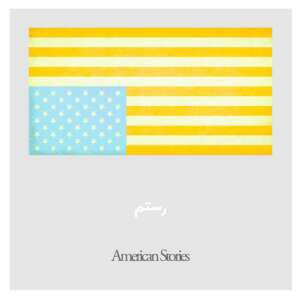
Perhaps more so than most albums, both the title of ‘American Stories’ and its artwork - an upside down flag of the USA - are crucial parts of the project. “The process for me was about wanting to explore my own relationship to being American,” Rostam muses of creating the artwork, explaining that “it’s a unique relationship in the context of my family, because my mom was carrying me in her womb when my parents moved to America. I was born in America; my brother was born in France; my parents were born in Iran. So I’ve always had this specific relationship to being American that I’ve had to contend with, in a way; I’ve had to ask myself if the flag is something that I believe in or I reject… I’ve had to ask myself what it means to me.”
“I think what I’m asking myself to do is to believe in investing in what I call the American project, which is something…” he pauses, then offers: “It’s a wider net than what America has been historically, and what America is today. It’s an ideal. And when I look at the flag as representing that, I do feel aligned with it. I do believe in what the flag has to say in its idealistic sense, even if I disagree with so many of the people that have tried to manipulate nationalism or patriotism to serve their own politics. I think there’s a part of me that feels like it’s important for the flag to have meaning, to a larger swath of us who are American.”
On record, these themes are manifested potently, perhaps best so via the gorgeous electric and acoustic saz lines of ‘Forgive Is To Know’ (“A thing about forgiveness / Is that it takes a change / Where once you were a victim / You no longer feel the same”). His titles, he explains, are intentionally vague; ‘American Stories’ is intended “in some ways [as] a blank canvas that anyone could bring their own thoughts, their own experiences, their own biases, perhaps, to.”
“I do believe in what the flag has to say in its idealistic sense, even if I disagree with so many of the people that have tried to manipulate nationalism or patriotism to serve their own politics.”
Though it’s quietly been in the works since ‘Changephobia’, there wasn’t a specific moment where Rostam actively ‘started’ his latest chapter. In fact, the earliest sketches of ‘American Stories’ go back to 2012, with tracks growing and evolving in the interim. “I had the vision of what I wanted to do in the writing process: I wanted to write 20 or 30 verses and then choose the best,” he asserts. Some lyrics, though, struck like bolts from the blue: “some of my favourite lines were things that I wrote on the spot the day that I recorded those vocals,” he smiles. “There’s a quote from Julian Casablancas that says ‘you spend hours and hours working on something so you can have 20 minutes of inspiration that doesn’t feel like work. And it’s in those 20 minutes of inspiration that the real work happens’.”
Elsewhere, Clairo - who Rostam first worked with when he co-produced her debut record ‘Immunity’ in 2019 - features on ‘Hardy’. Built around cinematic strings and skittering electronic rhythms, the song unravels the end of a relationship, with Clairo’s vocals heralding a change in perspective, both musically and lyrically. “I think I was a little bit nervous when I presented the idea [to her],” Rostam admits. “Anytime you say that to someone… it’s a bit nerve wracking.”
Unsurprisingly, Clairo jumped at the chance, after which he says their collaboration “felt very natural”. “She makes those lyrics really work; because they’re such a different perspective from the rest of the song, I don’t think it would have made sense if I sang them.” Indeed, when Clairo’s vocals appear, the narrative becomes “novelistic”, as the point of view of the story changes between characters. Rostam’s hesitant to use the word ‘epic’ to describe the musical and structural change that ensues, but we’re not - it’s a hugely cinematic moment, and one that’ll soar in his upcoming live shows.
Throughout ‘American Stories’ are many such brilliant - and, yes, sometimes epic - moments: take the stop-you-in-your-tracks lyrics of ‘The Road to Death’ (“And Jesus Christ is a beautiful idea / Does it matter if he was real? / My father carries the name of a prophet / But Dad was no believer”); or the earworm opening riff of ‘Back Of A Truck’; or the sheer compositional might of each and every arrangement. The result is a stunningly crafted, deeply personal, and movingly poignant record, a collection that’s as unafraid to ask questions of its listener as it is to suggest answers.
As for Rostam, he’s already looking ahead, pondering the next challenge. “Maybe I should just make another album, put it out,” he nods. “I’m feeling like I’m in artist mode: ‘let’s do it again’. It’s already feeling like it’s time!” If it’s half as good as ‘American Stories’, we can’t wait to hear it.
Memory Lane: 20 years on from the formation of Vampire Weekend, Rostam looks back on those heady early days.
“I was really focused; at every moment I was so focused on making the records, [thinking about] what the next record would sound like and look like. That time in my life is very much connected to living in New York, which happened when I was aged between 18 and 30 - a very specific time to live in New York in a person’s life. I have memories of taking the subway to Radio City Music Hall from my apartment in Dumbo to perform in September 2010, you know? That era of my life was very much connected to NYC, in a positive way.”‘American Stories’ is out now via Matsor Projects.
Records, etc at


As featured in the May 2026 issue of DIY, out now.
More like this

Rostam - American Stories
4 Stars
A record of reflection and connection that ranks among the more beautiful-sounding you might hear this year.
13th May 2026
Rostam shares poignant latest LP preview ‘Back Of A Truck’
It combines elements of Americana and Persian music to encapsulate what he calls “the America I know”.
24th April 2026

Rostam announces new album ‘American Stories’
The producer’s third solo full-length is due for release in May.
12th March 2026
Rostam announces ‘Changephobia Remixes: Part I & II’
Check out A.G. Cook’s remix of ‘Kinney’ now.
2nd November 2021

Featuring Yard Act, Death Cab For Cutie, Graham Coxon, Maisie Peters and more.