
Interview Shame: Cut To The Chase
Four albums and 11 years in, if you thought Shame might be losing their edge, think again. On new album ‘Cutthroat’, the South Londoners delight in all things paradoxical, and return to their urgent, basic instincts.
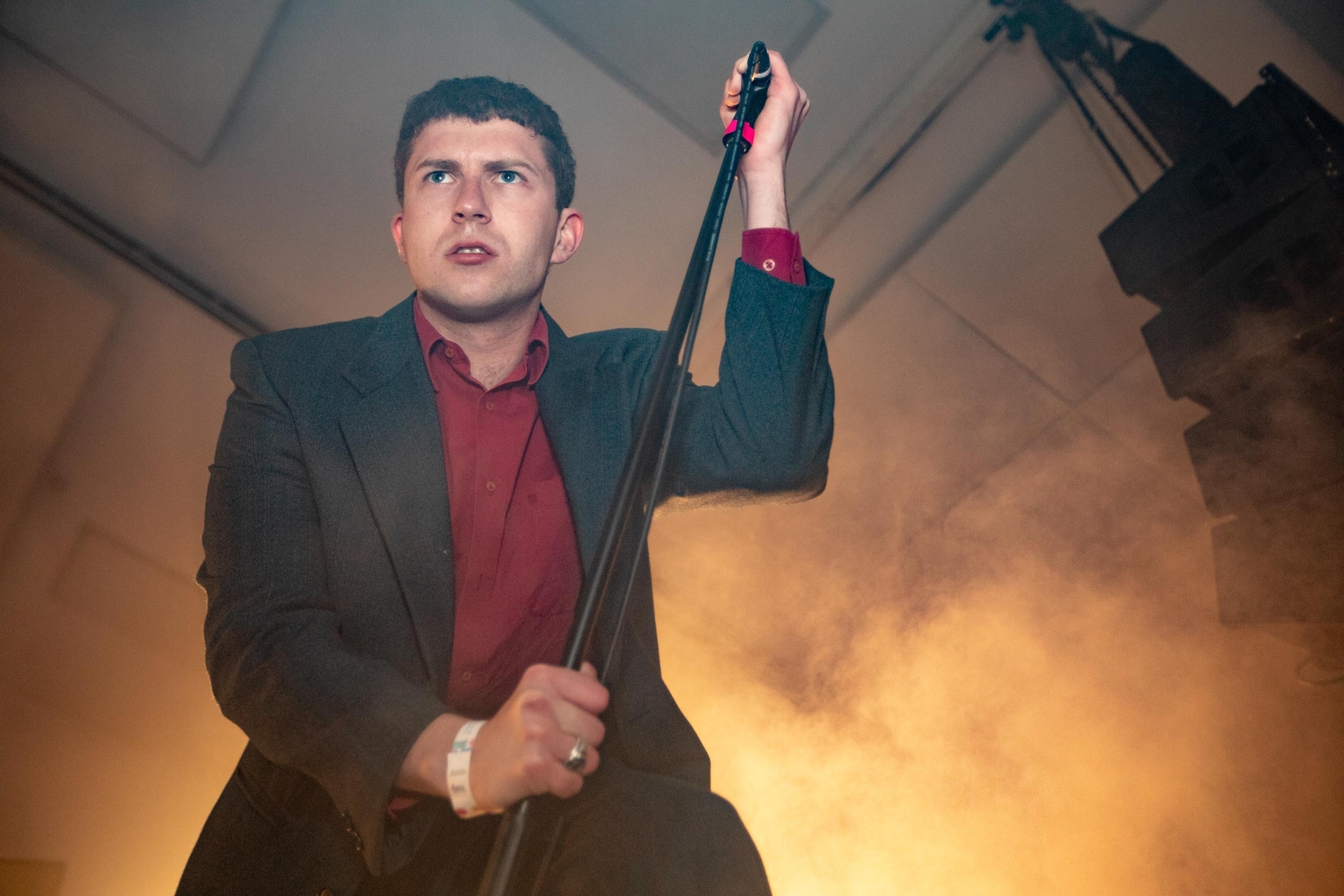
“I had maybe three hours sleep, I think?” Charlie Steen says, as he rubs his eyes and lights a cigarette on the balcony of his flat. It’s a swelteringly hot afternoon in South London, the start of yet another heatwave, and the Shame frontman has been home for less than an hour, having just flown back from an Italian festival. His sleep deprivation is self-inflicted, though: “It’s my birthday, so I changed to an earlier flight. We didn’t get back from the festival until 1:30AM, and then I couldn’t sleep for two hours … but tomorrow I’ll celebrate.” He grins. “It’ll be lovely.”
There’s still something of the eternally cheeky teenager to Steen, four albums and over a decade on from his formation of Shame at school with four pals - Sean Coyle-Smith, Josh Finerty, Charlie Forbes and Eddie Green. You still get a sense, above all, that he can’t quite believe that he’s getting away with it, and that being in this band is how he spends his time. The reason for our conversation is the imminent release of the band’s fourth effort, ‘Cutthroat’, and the ensuing 40-date European tour (to say nothing of their commitments further afield).
The album itself is Shame at their most technicolour: dial everything up, set off all the fireworks. The title track - and first single - is a statement of intent, driving and bombastic. We find Steen in the commanding, almost slapstick American register that he so often loves to slip into. “Big, beautiful naked women fall out the sky / Motherfucker, I was born to die” is quite an opening line. “I think that whole song in itself is a statement - I think it’s just fun, you know?” grins Steen. “It’s been going down so well live, even before it came out. It’s not super serious, it sort of does mean something in some bits, and doesn’t mean anything in other bits.”
He hits, here, on something that Shame have always delighted in - the freedom offered by parody. Knowingly exaggerated writing affords them the luxury of taking the piss out of something - including, at times, themselves - walking the tightrope between astute cultural commentary and self-aware silliness with gusto. “I knew, pretty much ages before we did the record, what I wanted to write about,” explains Steen. “Which was paradoxes, characters. So much of it - ‘Screwdriver’, ‘Plaster’, ‘Lampião’ - is about characters. Even with ‘Cutthroat’, it’s almost like I was writing from the viewpoint of the character from when we perform, which is me, but just heavily exaggerated.
There’s an amount of this self-inspection elsewhere on the album, too. “With ‘Spartak’, I remember I had the chorus before [the rest of the song]: okay, so “you’re no better than me”, what’s that? What’s that kind of vibe?” Steen asks. “And it’s someone - probably me - pissed up, walking back from a party or something like that, pissed off at someone there, talking to yourself.” Steen’s writing often seems to be trying to pre-empt others’ judgement, finding the strength in not taking yourself too seriously. “That’s another sort of paradox to it, where I’m like ‘do whatever you want to do, fuck judgement’ - but I’m also heavy with a lot of judgement.”
He pauses. “Even with ‘One Rizla’ [which has a chorus of “I ain’t much to look at / I ain’t much to hear”], or taking my top off because I was insecure about my weight … all these things come across with a bit of anger, and I think it’s sort of a liberation from the feeling of rejection.” Steen does feel, though, that ‘Cutthroat’ takes a different approach to soul-searching than the band have done on previous albums. “I love all of our records, but I think the last two were a bit more melancholic maybe, and a bit more introspective. And this [album] is basically going away from ‘poor me’, and trying to go back to ‘fuck you!’”


“This [abum] is basically going away from ‘poor me’, and trying to go back to ‘fuck you!’ ”
— Charlie Steen
This could all make these tracks sound somewhat dreary, or dark, but they’re not at all. All of the aforementioned self-knowledge is couched in humour, and a smirk, and combined with the sound of a band that have been hammering riffs together for some time now. It’s quite the cocktail. “In a lot of those songs, I was smiling while doing vocal takes,” says Steen. “I am pissed off at things, but it’s just a sort of release. It’s not ‘let’s all hold hands and sing Kumbaya’, but it’s not melancholic.”
This feeling of release, of self-embrace, and of self-realisation, all feels summed up in the chorus of ‘Cutthroat’: “And why not?” It feels somewhat of a mantra, both for the band and for the album, and it’s a phrase peppered through Steen’s answers, a refrain for when it feels you’ve overstepped the mark, and for when self-doubt creeps in. “With some of the lyrics [the band] were like ‘I don’t know…’” grins Steen. “I said ‘I know it sounds weird when we’re sat chatting and listening back, but when you see this live and we’re performing it, it’s not going to feel strange, it’s going to feel good.’ And that’s kind of exactly how it’s been, this kind of obnoxious, unashamed character who’s doing what they want to do.”
As much as the album plumbs Steen’s psyche, and reflects a band who have spent so much time in each other’s company, someone else has fingerprints here too - producer John Congleton. The band have had someone different at the mixing desk for each of their four albums, and they’ve credited John’s “no bullshit” approach as essential to proceedings here. Steen nods. “We all love that Mannequin Pussy album that he did [‘I Got Heaven’], and that just sounds real - no bullshit. I’m sure he’s different with everyone - he’s such a big producer, he’s worked with people like Lana Del Rey. He’s American, we met up with him in Brixton when he was over here, and we said ‘look, as a band, some people are fine with engineers who just sit back. We’re not like that, we’ve never been like that’. We need a - in his case - paternal figure, to be like, ‘this is good, this is shit.’”
It’s easy to imagine that kind of feedback being difficult to take. How did John’s paternal instincts manifest themselves? “He sent three words over when we were writing: ‘primal’, ‘dangerous’, and something else. It just doesn’t feel that overthought, you know? I think we may have been a bit partial to that in the past, and John just really helped to … stop us thinking,” Steen laughs. “We needed him to be brutal, and that’s exactly what he did. Because otherwise, we’ve known each other for so long that there isn’t a quote-unquote ‘leader’ of the band.” He grins. “It’s sort of where democracy fails.”
“In my opinion, the best shows are when you’re not thinking, you’re acting purely on instinct.”
— Charlie Steen
Some bands, at the point Shame are at in their career, form long-standing relationships with producers - they feel almost as crucial as actual members of the group. Steen and co.’s decision to instead keep building new creative relationships feels telling, of a band that are resolutely pressing ahead, rather than looking back. “I think we still look at it as if each hour might be our last,” he ponders. “And, why not? Why not look around and work with different people? It’s proven to be really fun, and really enjoyable. It’s just like, ‘okay, time to make a new mate’, you know?”
The band also pursued a much more dynamic approach to the songs themselves than previously - much of the material was worked out while in the studio, with John constantly pushing for a leaner, tauter record. “The thing he was focused on was finding the identity of the song. I was also doing the lyrics while in the studio, which I’ve never done before. With some, the structure was there and bang-on, like ‘To and Fro’, and then there were others, that were quite long, had lots of different sections. He was like, ‘what is the root of the song? Don’t overcomplicate it’. That really helped, especially with doing the lyrics as well. When you find out what you think a song is about, it’s usually not composed of that many elements.”
It feels odd, in some ways, dissecting Shame albums with Steen - almost like pinning a butterfly to a wall. The band may be on record number four, but it still feels, more than anything, that they’re primarily a live endeavour. To be in the audience for a Shame show is quite something; it’s par for the course to witness bassist Josh Finnerty do a front flip while still playing, while the frontman himself has been known to rip his trousers off to reveal gold hot pants (and he’ll inevitably have been topless almost from the get-go). But don’t for a second think that they’re a band of gimmicks: this is all underpinned by the kind of live chops that evidence a career started in sweaty pubs and small venues, an innate knowledge of how to hold a crowd in the palm of your hand.
Despite all of this, he’s been quoted as saying that their live shows “aren’t performance art”. It feels tied up in his endeavours to “trim the fat” on ‘Cutthroat’, a pursuit of cutting away the unnecessary, finding out what’s happening at the core of them as a band. “It’s going back to the primal and raw thing,” says Steen. “In my opinion the best shows are when you’re not thinking. You’re acting purely on instinct. I would hope that it doesn’t feel so pre-constructed, that it feels more direct and confrontational, because that’s what it’s supposed to be, you know? It’s not supposed to be this ‘art’ thing, because I don’t think we want to put ourselves in a bracket of ‘we are this, and you are that’. There’s not supposed to be a separation between us and the crowd, basically.”
They’re a proudly unrefined live proposition too. Steen is keen to stress, again, that they view the crowd as an essential part of the equation, even when the band themselves don’t feel too hot. “I’ve never played a show where the crowd weren’t into it and we’ve played perfectly, and walked off and been like, ‘that was great’,” he explains. “We’ve played shit, we’ve played terribly, had a great crowd and been like, ‘that was fucking amazing’.”
Talking to Steen, it’s impossible not to get swept up in his relentless love for what he does. There’s none of the jaded cynicism you might expect from someone who’s been around the block many a time. When Shame first started out back in 2014, they were still in school. Their rise saw the music press fascinated by the milieu of bands they hung around with at Brixton’s Windmill, with contemporaries such as Goat Girl and Squid. But it feels now that the band have come out of the other side of that process - Shame have outlasted any kind of ‘moment’, and have become a force unto themselves, ploughing their own furrow.
‘Cutthroat’ is a slippery record. Brash and yet vulnerable, playful but deadly serious. It’s a portrait of a band who still, a decade on, are flying by the seat of their (gold) pants. Somehow, that way of being seems to ensure that they go on and on. And why not?
‘Cutthroat’ is out 5th September via Dead Oceans.
Records, etc at


shame - Songs of Praise

shame - Drunk Tank Pink - Deluxe

shame - Drunk Tank Pink

shame - All The Hits
As featured in the July / August 2025 issue of DIY, out now.

More like this
Reeperbahn Festival adds 70+ new names to 2026 lineup
Shame, Bleech 9:3, Lowertown and more are all heading to Hamburg this September.
26th May 2026
Shame - Cutthroat
4-5 Stars
They’ve never sounded more self-assured.
3rd September 2025
Shame preview ‘Cutthroat’ with ‘Spartak’
The outfit’s fourth album is released next month.
15th August 2025
Kevin Abstract is the cover star of DIY’s July / August 2025 issue!
Our bumper summer mag also features Shame, Kae Tempest, Indigo De Souza, Black Honey and loads more.
23rd July 2025

Featuring Yard Act, Death Cab For Cutie, Graham Coxon, Maisie Peters and more.