
Cover Feature Japanese Breakfast: Melancholy and the Infinite Sadness
With her last album ‘Jubilee’, Japanese Breakfast’s Michelle Zauner found herself a GRAMMY-nominated artist with a New York bestseller to her name, but no amount of critical acclaim will shift the reality of loss. Now, ten years on from the passing of her mother, her grief is still unfolding, and she’s channelling it into the dark new world of ‘For Melancholy Brunettes (& sad women)’.
Anyone who has ever taken out an involuntary subscription to the Grief Club will already know this: when you’ve lost someone you love, sadness tends to show up in the weirdest ways.
Grief is feeling guilty for laughing at a corny joke, being irrationally furious with people who are sad for milder, less tragic reasons than you, or fuming that someone is no longer here to experience incredibly trivial developments such as alcohol-free Guinness, or Sex and the City’s brilliantly terrible reboot. Grief tends to underpin almost everything, and even as time marches on, life seems to be divided into before and after. “I still very much think of my life as being folded around that event,” says Michelle Zauner, aka Japanese Breakfast, “and I think I probably always will.”
For Japanese Breakfast, much of her work exists in the ‘after’ – with her three albums to date, and 2021’s breakthrough memoir Crying in H Mart, all grappling with the passing of her mother. “It’s been 10 years since my mother passed away, and I’ve changed a lot,” she says today, as we catch up over Zoom. “This is a thought I’ve been having a lot that’s not fully formed, to be honest: but when I look back at my catalogue, I think of [2016’s debut album] ‘Psychopomp’ as this extremely raw interpretation of grief. I think of ‘Soft Sounds [From Another Planet]’ as this real kind of dissociative state that came after it. And I think of ‘Jubilee’ as a sort of permission to feel happiness.”
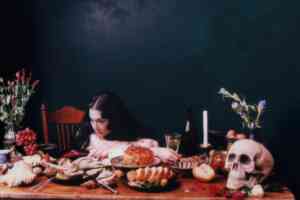
New album ‘For Melancholy Brunettes (& sad women)’, on the other hand, is concerned with creating room for other shades of sadness again; a gloominess that is gentler, and more reflective. It is also a conscious departure from ‘Jubilee’’s warmer, brighter sound, and sunny aesthetics: “I never wanted to see the colour yellow, ever again,” she jokes.
”In a way, melancholy is my innate form,” she says. “I don’t think my grief will ever be over, but in some ways, it feels like it’s come full circle. I’ve allowed myself to feel happiness, and I’ve allowed myself now to just be sad about other stuff. Especially being someone in her mid-30s, sadness is not what it used to be. It’s not the sort of intense heartbreak, or jealousy, or longing; it is this kind of pensive melancholy about time passing.”


After recording ‘For Melancholy Brunettes (& sad women)’, Michelle spent a year living in Seoul, taking a kind of sabbatical following the dizzying success of her two-time Grammy nominated third album, and her best-selling memoir Crying in H Mart in 2021. Both projects catapulted her firmly into the cultural mainstream, and were met with critical acclaim beyond most artists’ wildest dreams; but it all left her feeling like Icarus flying too close to the sun, complete with waxy wings beginning to melt.
“I kind of felt like I was at a high stakes poker table, and I had just won a lot. All I could think is, ‘I have to leave before I start losing’.” After a decade-plus touring the US in a moderately successful indie band, Michelle began to struggle with stage fright and anxiety as the bigger, shinier bookings came knocking. Her mental and physical health both suffered as a result.
”I never thought we would play Saturday Night Live, I never thought we would play late night TV. I never thought that we would play Radio City Music Hall, or that I would go on to do all these things. I just was happy being in a van, you know, playing small shows,” she nods. “I used to get drunk a lot, and play shows sort of sloppily… when all of a sudden, you’re playing for 1800 people and tickets are $40, or $80, you realise that it doesn’t fly anymore. So I was having to kind of learn how to basically throw a big party six nights a week, dead sober for the first time.” The pressure heightened to such a degree that Michelle wondered if she could continue making music.
“I felt so lucky, but so scared,” she says. “I think the most surreal thing is just being able to feel financially safe, doing what you like to do. That is the most life-changing surreal thing.” Unfortunately, this kind of setup is also not the reality for most musicians. “Totally,” she agrees. “That was not lost on me, and part of what made me feel so freaked out. I have so many incredibly talented friends who deserve that, and I felt like it had gone to the wrong person.”
In Seoul, Michelle spent most of her time at language school learning Korean, reconnecting with family, and making new friends – she kept a diary during this period, which will eventually become the basis for a second book. Though she felt recharged and ready to re-embrace Japanese Breakfast again by the end of the year, leaving Seoul also felt bittersweet.
“It was so beautiful, but it was quite sad when it ended, because I realised there is a version of me that lives here forever and just studies Korean and stars in this new life, but then there’s this other life that I built that closes, if I choose that path. I could just go today and live in Spain and study wine and become a sommelier…. but I’m probably not going to do that, because I would then have to close this chapter,” she says. “I’m probably never gonna learn how to do a backflip,” she quips, laughing. “There’s a kind of melancholy in watching your life pass.”
Though it was written long before Michelle arrived in Seoul, similar ideas are also woven through ‘For Melancholy Brunettes (& sad women)’. “This is clearly not a record where I was like, ‘this is going to beat ‘Jubilee’’,” she says knowingly. “I knew I wanted to make a record sort of in stark contrast to [‘Jubilee’], so I knew it was gonna have a darker palette, both visually and sonically. I also knew I really wanted to make a guitar album. The arrangements for ‘Jubilee’ were so large that, a lot of times, there wasn’t really room for me to just play guitar, and I was fronting as a singer. That made me really uncomfortable, I think, for the last three years.”
“Initially, I really wanted to make a creepy record,” she adds. “I thought that was a really interesting prompt.” The writing process began with tracks like ‘Honey Water’ and ‘Mega Circuit’, and “a lot of these weird, suspended, dissonant chords”. Gradually, though, she was drawn back towards melancholy instead, and became fascinated with mythology and its fallible heroes, riddled with tragic flaws.
“I’ve always been really interested in mythology, especially Greek mythology, because I think it’s really fascinating to have these gods that are not holy, you know, they’re not good people. They’re actually all quite corrupt and powerful. They abuse that power, make mistakes, and are unfaithful and cruel. A lot of these songs… I don’t think they’re moral tales, but they are dealing with people who are grappling with right and wrong.”
“I think that I discovered that the kind of through-line for all of these songs is strangely about people who succumb to some sort of temptation, or are on the precipice of disrupting some sort of balance in their lives. They’re either suffering the consequences, coping with regret, or trying to figure out how to move forward. As I began writing more songs, I realised that was the narrative arc, and connective tissue.”
Michelle also drew on a writing technique she’s enjoyed since her old band Little Big League: “writing from perspectives that I find hard to understand, or find scary.” As such, several songs on ‘For Melancholy Brunettes (& sad women)’ are voiced by men grappling with feelings of isolation or being misunderstood. An undercurrent of violence fizzles underneath ‘Mega Circuit’; “Plotting blood with your incel eunuchs,” she sings, “I could be the home you need.”
“What I really enjoy about writing music is that it’s quite easy and natural to float between fiction and non-fiction,” she notes. “I don’t know where they really came from… I think maybe what I was reading, or ideas I was preoccupied with in my personal life, or politically, you know, for ‘Mega Circuit’.”
“When I think about that type of temptation, I think about a young generation of men who are dealing with a shift in power, and feeling isolated politically, and are being tempted by a political party that embraces them the way that they feel they are, instead of punishing them for having different ideas or being confused,” she says, nodding to an all-too-present issue unfolding right now. “It’s a conflicted feeling of wanting to embrace a generation that is lost, and that being a serious political problem for everybody.”
“I think I was preoccupied by that for ‘Orlando in Love’, too. I was reading The Magic Mountain by Thomas Mann. I really loved that protagonist, and I found the way he’s written so charming. I had that kind of character in mind: this whimsical, fancy, but foolish man that’s kind of dumb and gets kind of manipulated into staying in the sanatorium. When I read about Orlando [in Matteo Maria Boiardo’s epic poem Orlando Innamorato] I had this vision of this man by the sea getting seduced by fire. ‘Little Girl’ is a song about a father who has made a lot of mistakes in his life, which has led to this kind of a strange relationship with his daughter, and he’s kind of lamenting those choices.”
“I have a hard time understanding that perspective, and I think there’s this desire to have compassion for that type of person, to get a better understanding of it,” she says, referencing her aforementioned writing technique. “I think we’re closer to resolving the problems with that, if we are approaching it with thoughtfulness and compassion,” she adds, “instead of just rejecting it completely. I think that is more productive, and so I think that’s what makes me want to reach for that.”


It also feels like something of a departure from the intensely autobiographical nature of Crying in H Mart – the memoir which transformed Zauner from indie musician to wildly acclaimed writer. In it, she reflects on her relationship with her late mother, with the memoir exploring how Michelle turned to recreating the Korean dishes she always used to cook as a form of remembrance.
She writes about this journey with the kind of honesty that is very difficult to look away from, examining multiple shifts in state following that loss, and articulating the messier, more complicated parts of grief with an eviscerating accuracy. “Conscious that the success we experienced revolved around her death, that the songs I sang memorialised her, I wished more than anything and through all contradiction that she could be there,” she writes in Crying in H Mart.
Unsurprisingly, the memoir has struck a chord with readers, who often share their own experiences. Sometimes, she admits, she “feels let down by my own response” to other people’s grief: “I wish I had something, beyond ‘I’m so sorry’ or ‘I’m here with you’.” Describing herself as an open person who doesn’t particularly care for being withholding, or small talk, she is instead more comfortable with the intense conversations her writing occasionally welcomes, and feels grateful for the chance to memorialise her mother’s character, and the imprint she has left on the world.“I wanted people to know what I went through, because I felt like, otherwise, people wouldn’t be able to understand me as a person – and that’s something I’ve always been afraid of,” she says. “If I were to meet you at a party and it came up while we were talking about other things,” she notes, “I would feel really comfortable speaking about it.”
On ‘For Melancholy Brunettes (& sad women)’’s closer, ‘Magic Mountain’, Michelle speaks from the perspective of Hans Castorp; the main character in Mann’s German novel of the same name. In the novel, Castorp leaves behind his usual life to stay in a sanatorium high in the Swiss Alps, where time seems to move differently. After escaping a deadly blizzard he has a realisation that he soon forgets: “Because of charity and love, man should never allow death to rule one’s thoughts”.
Given her journey over the last few years, retreating out of the spotlight to avoid the shadow of expectation, this closer can also be interpreted as an allegory for artistic legacy. “Bury me beside you,” she sings, “in the shadow of my mountain.” Does she spend much time dwelling on her own legacy? “I don’t know if I think much about it,” she admits. “I think I am more fixated on saying the things I want, or exploring the things I want.”“I was talking to a friend of mine, and we were discussing a different artist, and he was like, ‘I feel like when they made this record, it was like they were having a conversation with you like this’,” she says, shifting her gaze to speak to an invisible figure out of view. “And then the next record was like this,” she says, looking the other direction. “It’s like that feeling of when you’ve been abandoned by an artist because they’re looking to find someone else at a party, and that connection is lost.”“I want to have a legacy where I never have that moment with people who enjoy my music. I just never want to do anything phony. That, ultimately, is the most important thing for me.”
We hear you’re a big fan of The Great British Bake-off?
I love [2021 contestant] Lizzie Acker. One thing that my band and I quote a lot is when she says ‘I’m behind’, whenever she’s like, falling behind the other bakers. That is quoted a lot in my life, and in the band, either when we’re running behind with something, or falling behind physically while we’re walking somewhere.
Every single thing that [fellow 2021 contestant] Jurgen Krauss has done is my favourite moment. He’s so charming, especially when he starts talking about playing the trombone. He actually played trombone with us at our last show in London. When we toured for ‘Jubilee’, we were coming right out of COVID, and it was a very intense, stressful time, with all of us in a very strict bubble. One really sweet thing that we did, though, was watch Bake Off together; instead of going out to the bar after the gig, we would go into the bus and all watch Bake Off like little nerds. We all fell so hard in love with Jurgen. I mean, he is such a fun character, and such a singular man. As a pipe dream, we DM’d him to see if he would be interested in playing with us at our show in London, and he was down! I’m really happy to have a relationship with him.
How would you fancy your chances on the celebrity version?
Very low. I’m not a baker. I don’t know how to bake at all. I would not fare well. I think I made one nice zucchini bread once, and that’s the extent of my baking.
‘For Melancholy Brunettes (& sad women)’ is out 21st March via Dead Oceans.
Records, etc at


Japanese Breakfast - Soft Sounds From Another Planet

Japanese Breakfast - Jubilee

Japanese Breakfast - For Melancholy Brunettes (and Sad Women)

Japanese Breakfast - Psychopomp
As featured in the March 2025 issue of DIY, out now.

More like this
Japanese Breakfast - For Melancholy Brunettes (& sad women)
5 Stars
Both a leap in musical maturity as well as a callback to vintage Japanese Breakfast.
19th March 2025

Japanese Breakfast is the cover star of DIY’s March 2025 issue!
Our new mag also features Divorce, Perfume Genius, Julien Baker & TORRES, Matt Maltese, and loads more.
10th March 2025
Japanese Breakfast shares lush new album preview ‘Mega Circuit’
She’s also added more dates to her upcoming ‘For Melancholy Brunettes (& sad women)’ tour.
13th February 2025
Japanese Breakfast shares new video for latest track ‘Orlando In Love’
It’s the lead single of her recently-announced fourth LP, ‘For Melancholy Brunettes (& sad women)’.
14th January 2025

Featuring Yard Act, Death Cab For Cutie, Graham Coxon, Maisie Peters and more.