
Interview Allie X: Happily Ever After?
Just a year on from the release of her last, self-exorcising offering, Allie X has returned with a new rumination on the world, this time in the form of a daring, resistant album that refuses to compromise in its search for contentment.
As a kid, I got the sense that there was no greatness without struggle,” says Alexandra Hughes, better known as Canada’s alt-pop auteur Allie X. She’s fresh off a flight from London to New York; in a few days, she’ll be back in the UK. With just ten days to go until her fourth record ‘Happiness Is Going To Get You’ drops, she’s in overdrive.
It’s been a whirlwind: while touring 2024’s glam-rock tour-de-force ‘Girl With No Face’, Hughes was already onto the next, catching melodies from the air, rushing to the piano, recording demos on her iPhone. “If you spoke to people on my team, they’d say, ‘this girl could stand to slow down’,” she laughs. “But I like to move fast. I don’t want to waste time dilly dallying.”
Indeed, Alexandra has never shied away from grandiose visions or the speed at which they germinate, nor is she ever unprepared to suffer to marbleise them. Enduring chronic illness for over 20 years, Hughes describes herself as “far from an ideal candidate for a pop singer”.
“I relate to the idea that you can’t feel the joys without the suffering,” she admits, citing the Law of Opposites, a philosophy that posits universal balance in all things, including success and hard work. “I’ve always wanted big things, always had ambitious ideas. It’s hard to shake that belief. Therapists, intelligent and reasonable people, friends and partners - they’ve all said, ‘girl, it doesn’t make sense’. But I just can’t shake it.”
Take ‘Girl With No Face’, a maddening exaltation of her mind, body, womanhood and the modern dystopia, critically acclaimed for its deft solo production and fidgety resistance to pop’s status quo. Knuckling down to achieve creative and financial independence was a “steep learning curve”. But, as the Law states, the blood, sweat and tears paid off. To say she’d mastered the gruelling task of regaining control in LA’s rigid pop conveyor belt would be an understatement. “Being a woman who’s serious about her business in the music industry is a difficult position to be in,” she confesses of her agency. “But I’ve got a more well-oiled machine now. I’m able to manoeuvre much faster than I could before.”
“I’ve always wanted big things, always had ambitious ideas. It’s hard to shake that belief.”
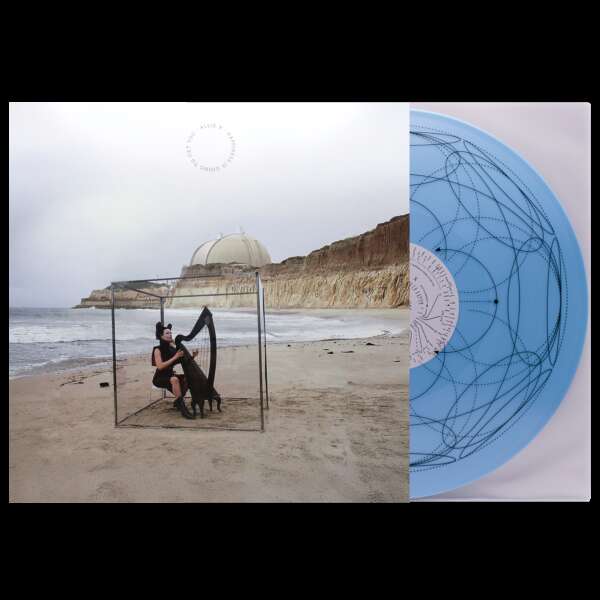
Strangely, this fourth record, ‘Happiness Is Going To Get You’, was less of a struggle. In fact, it “fell from the sky, into [her] mouth,” and was completed within a year. Drawing Hughes back to the piano where she first started - a “full circle” moment, she says - it naturally welcomed steady reflectivity on the toil she puts into her work. Following its predecessor’s ‘complete ego-death’ then, comes languid, liminal nostalgia; a grasping for new spirituality among all the spewed debris of her self-exorcism. In this way, her new album is somewhat of a companion piece - a counter to rage, and a consequential settling into the strangeling artist she always sought freedom to be, Yet, this new project is still singular.
Largely, its soundscape comprises harpsichords, orchestral stabs, timpani, imitation zithers, the Wurlitzer and the Rhodes: a move away from “fantasies of glamour” into the strange, the classical, the ornate, the gothically unappealing. Loosely, it’s inspired by the baroque-pop of Tori Amos’ 1996 record ‘Boys for Pele’ - a provocative figure in pop, Hughes describes, who greatly fascinated her as a child.
“I felt naughty and too young to be listening to it, or looking at the artwork: Tori with a suckling baby pig on her tit. It’s provocative. It planted in my subconscious.” Amos also roused an admiration for skilled showmanship: “As a person who’s studied classically, to watch Tori play the harpsichord on ‘Blood Roses’, and realise this is not just a keyboardist, but a prodigious player… it’s unrivalled. I’ve never seen anyone in pop music come close.”
There’s a clear through-line between Amos and Hughes; alongside an affinity for antiquated aesthetics, both have a knack for portraying the gruesomeness of imposed femininity. ‘Boys for Pele’ was described as a “rejection of the ideals of feminine and musical beauty” by writer Amy Gentry in her 33 1/3 book - an admirable expression of ugliness in pop. ‘Happiness…’ is similarly unconcerned with the gendered status quo.
“A big part of me wants to be liked, but I gave up trying to please people with my songwriting a long time ago,” says Hughes. Likewise in womanhood, while observing friends follow “quote-unquote feminine, traditional” lives, she instinctively sought its antithesis. “I’m still grappling with a resistance to maternal expectations,” she elaborates. “It’s something I reflect upon often - not yet in my songs, but I’ve written some for what might be a future record.” She later confesses, “I like becoming unlikable: not sweet and womanlike. That’s my path.”
The record’s alter-ego, the Infant Marie, captures this opposition. A crash-landed Victorian time traveller, donned in a strange, upward- winged ‘empress wig’ designed by hair director Virginie Pineda, Marie is portrayed as an oddity, a leader of misfits with a deep affinity for the earth, quantum physics and connectivity; abrasive, resistant, stubborn in her friction against conventional beauty in sound and dress. Hughes accredits the comfort of her transgressions to the queer community: “I’m so grateful there’s a space for me to be [this version of woman] that I am.”

“A big part of me wants to be liked, but I gave up trying to please people with my songwriting a long time ago.”
If ‘Girl With No Face’ embodied feminine rage, then ‘Happiness…’ reads as the clarity after the storm: self-emancipation still laced with disdain and heartache. “A woman free-falling through time, with tears in her eyes,” she notes. ‘Down Season’, for example, is a depressive episode that conjures The Bell Jar or The Yellow Wallpaper. “Send the hanging man in / Clip the rose at the stem,” she commands, “Nurse told me that I’ll never grow without my medicine.” She laughs: “I’m never going to make an empowerment pop album.”
But this record was earned by balance; a record of “joy” to make. “There’s a raping in the beauty,” she sings over the haunting title track, “You’re alive / There’s no escape.” Vis-à-vis, there’s peace in her friction with convention, in the marriage of greatness and struggle, in the tension between femininity and freedom. A full life, she calls it.
“I have this thing where you can’t knock me down. I have a strong sense of hope,” she asserts. “Maybe it’s delusional.” Hughes sees “the fragility of life and the devastating beauty of 60-100 years on Earth”, and thus respects the lessons the universe delivers. But don’t misconstrue Hughes’ hope for submission: Marie balks at the 21st Century. Case-in-point, the synth-opera ‘Uncle Lenny’ paints “redundant, straight, old white men, gatekeeping every industry by doing the bare minimum, being perverted in a way they get away with, and slowing women, queer people and people of colour down”.
‘Happiness…’ doubly draws attention to tech-induced disconnection, Mother Nature’s unrepentant suffering under capitalism, and lost spirituality. “I lived when there was no internet,” she recalls. “I called my parents on pay phones. Now my phone is like a limb. It’s apocalyptic.” Lead single ‘Is Anybody Out There?’ sees Hughes longing for reason amid contemporary normalcy, where heatwaves and recalled teabags and damnation from zealots requires numbing effects. Orchestral stabs tear through its arid production in search of answers to mysteries that may never be answered, but, yearning, she retains faith.
Faith ends up key to moving forward as an artist and entity in the modern dystopia: “I will bend to the light,” she sings on ‘It’s Just Light’, reflecting the toil of the spotlight, but equally the “immense beauty and enlightenment” that it provides. In this way, Hughes concludes that ‘Happiness…’ is somewhat a “reset” for Allie X. A return to the abstraction and spirituality her name first came to represent, and bygone naivety: “The X shows how confused I am, and how openly I’d like to live and explore art, which can be changing, becoming someone else,” she regales, revelling in the Jungian freedom her name affords in a rigid world. “I relate to the idea of the question mark as the identity. The shadow self surfacing as persona. ‘I don’t know who this [version of X] is’,” she told her partner about the voice and tone of the record, as it first began to coagulate. “The things coming out of my mouth were unfamiliar to me. I wasn’t sure where this came from.”
Indeed, ‘Happiness…’ came with far more ease than expected, from something out-of-reach she’s yet to fully understand, but to Hughes it’s proof of a pay-off from the universe. Greatness from struggle. Calm from rage. “Sometimes, you’re just a vessel for something flowing through you.”
‘Happiness Is Going to Get You’ is out now via Allie X / AWAL.
Records, etc at

As featured in the November 2025 issue of DIY, out now.

More like this

Allie X confirms plans for ‘Serial Diva’ UK & European headline tour
She’s announced an epic 28-date tour in support of her recent album ‘Happiness Is Going to Get You’.
30th April 2026

Allie X announces ‘Girl With No Face’ UK and Ireland tour dates
The pop provocateur will be playing three shows this May.
20th March 2024
Allie X - Girl With No Face
4 Stars
An energetic retrospection to digest all the mundane, vulgar, maddening and unsettling future contemporaneity she faces.
21st February 2024

Allie X - Cape God
2-5 Stars
There are undeniably beautiful and anthemic moments here, but on the whole it falls short.
20th February 2020

Featuring Yard Act, Death Cab For Cutie, Graham Coxon, Maisie Peters and more.