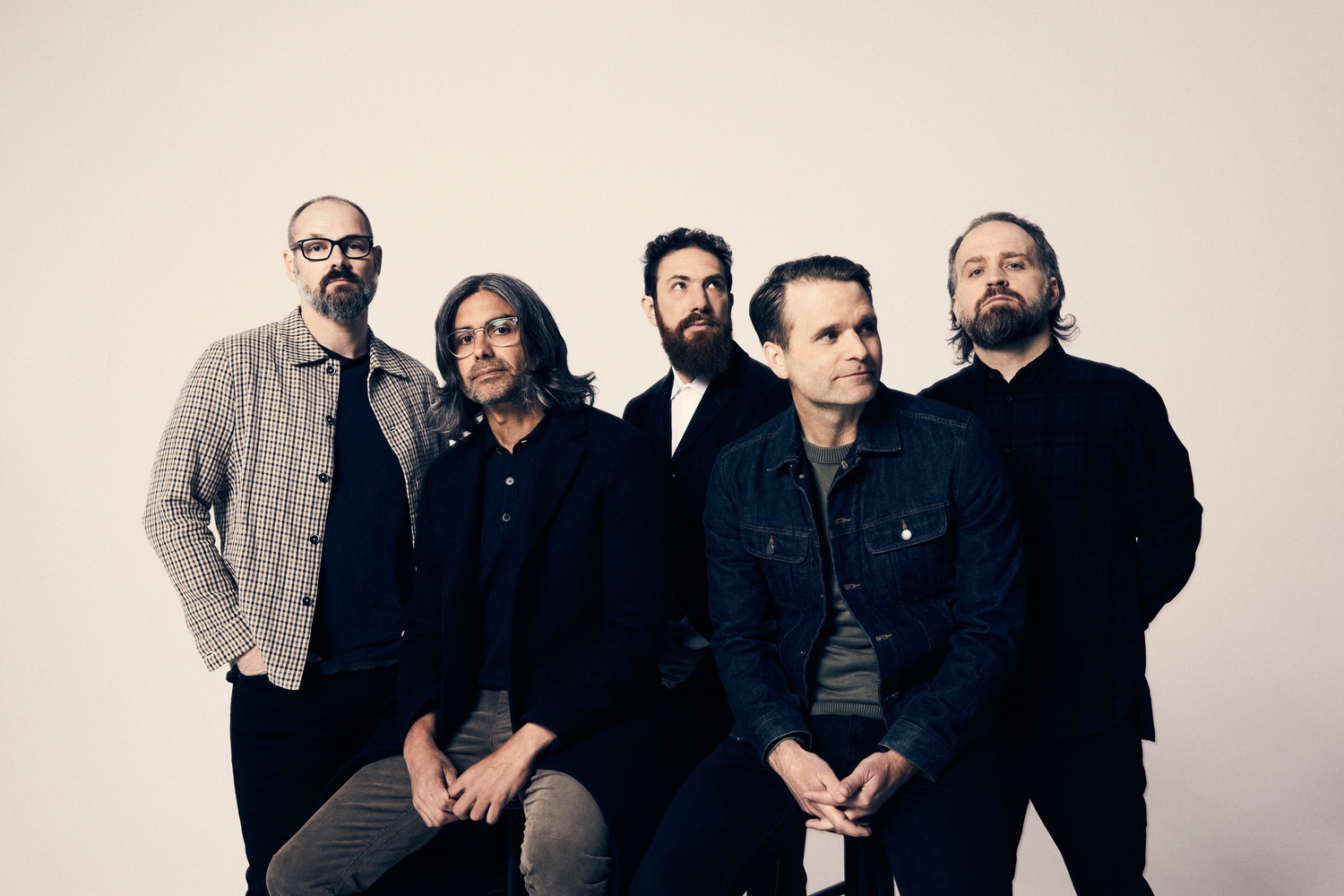
Interview Ben Gibbard on celebrating the anniversaries of ‘Transatlanticism’ and ‘Give Up’: “It felt like it would be foolish not to do it”
Ahead of their joint headline show at All Points East, we speak to the Death Cab For Cutie and The Postal Service frontman on twenty years of ‘Transatlanticism’ and ‘Give Up’.
2003 was Ben Gibbard’s annus mirabilis. It is not uncommon for an artist to make the records they’ll be best remembered for within one particular purple patch; there’s plenty of bands with towering legacies that did all of their most important work within the span of a few years. Gibbard’s two truly seminal albums were released 230 days apart.
‘Transatlanticism’ is arguably Death Cab for Cutie’s defining work (to date at least) - a record that set a gold standard for emotionally literate, handsomely melodic indie rock that few have matched since. For the band, it represented a snatching of victory from the jaws of defeat, given how close they had come to imploding spectacularly less than two years to the day of its release.
If there was a strange subtext to ‘Transatlanticism’, it was that Gibbard had already bounced back from Death Cab’s 2001 flameout. A chance meeting with Jimmy Tamborello, an electronic musician who imbued glitchy soundscapes with melodic sensibilities under the name Dntel, had led to a collaboration between the pair: ‘This Is the Dream of Evan and Chan’, a track that appeared on Tamborello’s 2001 album ‘Life Is Full of Possibilities’.
From there, The Postal Service was born, as Gibbard and Tamborello made futuristic pop together in a manner that was decidedly analogue then and charmingly quaint now - by sending demos up and down the West coast to each other via snail mail. ‘Give Up’, the record that resulted, gradually became a word-of-mouth smash, with Tamborello’s playful, infectious beds of synth providing Gibbard with a platform from which to expand his lyrical gaze outward, eschewing his Death Cab introspection to instead ruminate on everything from early signifiers of the climate crisis to the assassination of John F. Kennedy.
Now, two decades later, a place in the indie rock pantheon for both ‘Transatlanticism’ and ‘Give Up’ is assured; moreover, so is Gibbard’s. His is a unique position in history, as somebody to make two classic records so different from one another within such a short space of time, and when discussions began about marking the twenty year anniversaries, it wasn’t long before the idea of merging the celebrations crystallised. “It felt like it would be foolish not to do it,” he says of the decision to pull double duty every night by taking Death Cab and The Postal Service on a co-headlining tour of the US last Autumn. “Who else had two records like this in the course of one calendar year? Nobody. That’s something that’s become clear to me as time has moved on and we’ve gotten a better sense of the legacy of these albums - what they mean in the culture, so to speak.”
If their importance wasn’t clear when they booked the tour, it was by the time tickets went on sale; two sold-out nights at Madison Square Garden and a further three at the Hollywood Bowl tell their own story. In a recent Stereogum piece that investigated a spate of undersold arena tours in the States, Death Cab’s manager, Jordan Kurland, said that the ‘Transatlanticism’ / ‘Give Up’ tour had bucked the trend, lamenting that he had “undershot it in some markets” where shows sold out in minutes.
“There’s no way to say it without sounding a little bit self-aggrandising, but I can’t think of another person who could possibly do this.”
— Ben Gibbard
Now, Gibbard is gearing up for the biggest gig of the run as part of All Points East, on which his bands will be joined by a stellar line-up that includes his heroes (Teenage Fanclub, Yo La Tengo), his contemporaries (The Decemberists, Phoenix, Sleater-Kinney) and his stylistic disciples (Wednesday, Everything Everything). It’s a show that will provide a triumphant exclamation mark to a story that began back in 2002, as Gibbard was finally finding his feet as a writer.
“For the first five years of Death Cab, we were touring like crazy, and living hand-to-mouth,” he recalls. “By the end of 2000, after we’d had a couple of records and an EP out, we started making enough money to just barely eke out a living, but in order to do that, we had to tour constantly, which left me with no time to write.”
A variety of pressures within and without the band would eventually prove near-fatal as they toured their third LP, ‘The Photo Album’. “We ended up having a huge blowout on Halloween in 2001, in Baltimore. Just a huge argument where a ton of stuff that had been pent up came out, and we almost didn’t make it. We almost broke up that night. Thankfully, we came to our senses within a few days and realised we were all burned out, and needed time away. We could’t keep going at that pace.”
The break provided Gibbard with what he’d been craving; the time to be creative. “If there was anything about 2002 that informed the records, its was that it was the first time in Death Cab’s existence when I’d had the time to write and try new ideas without working to a deadline, without needing to rush something out so we could get back on the road. And because I had all this time on my hands, I could explore this project with Jimmy, too.”
Anyone familiar with the two albums will know how distinct they are from one another, which perhaps explains why The Postal Service will go on last at All Points East; they are the headline attraction for a legion of fans who adore ‘Give Up’, but never quite took to Death Cab the same way. Gibbard confirms that, whilst there was overlap between the writing of the two, he kept up an airtight seal between the projects.
“Everything Jimmy sent me was its own musical thought, and I was just reacting to that,” he says. “I was toggling between the two. This week a Postal Service song, next week a Death Cab one. And I’d come back to the Death Cab one invigorated from the work I’d just done with Jimmy. The process allowed just enough daylight between both projects that they could kind of each exist in their own space.”
“There are certainly moments on these records that were written in response to the times that we were living in at that point in the States.”
— Ben Gibbard
‘Transatlanticism’ occupies the more traditional Death Cab space, as Gibbard sifts through the pieces of doomed romances (‘Title and Registration’, ‘Expo ’86’, ‘Tiny Vessels’), examines the darker corners of his psyche (‘Lightness’), and observes parallels between his own life and the art that inspires him (‘Death of an Interior Decorator’), whilst finally taking ownership of his own voice, writing more pointedly and with less reliance on the style of his lyrical influences.
‘Give Up’ gave him the chance to write about things that wouldn’t fit within Death Cab’s parameters. It’s consistently playful, whether he’s reimagining a London romance as a Hollywood classic (‘Clark Gable’) or being deliberately arch about nuclear apocalypse (‘We Will Become Silhouettes’). “Jimmy set the tone, because he was sending me the music. Something like ‘Sleeping In’, it has a doo-wop chord progression to it that I would never write for Death Cab, and that lent itself to some very whimsical lyrics. A lot of Death Cab stuff, it starts with me sitting alone in a room, and that takes you to some melancholy places, and you write what’s appropriate for that mood. But I was taking Jimmy’s tracks on walks around my neighbourhood, and that took my brain to some new places, which naturally led to me writing from new angles.”
The last reunion tour from The Postal Service came in 2013, to mark ‘Give Up’’s tenth anniversary, and was chronicled in Justin Mitchell’s documentary Everything Will Change. In the film, Gibbard paints a carefree picture of his life in 2002: “it was a time when there was nothing happening in the world worth paying attention to other than indie rock. Making records, going to shows, and drinking beer. At the time, I didn’t care about anything other than making music.”
Despite that, there are hints throughout both ‘Transatlanticism’ and ‘Give Up’ that the nervousness that permeated America in 2002 had bled through some into Gibbard’s writing; the myriad references to climate change on the latter record seem especially prescient. “There are certainly moments on these records that were written in response to the times that we were living in at that point in the States,” he reflects.
“I just watched this documentary series on Netflix about the war on terror, and it had an unbelievable amount of graphic footage from 9/11. It made me incredibly emotional, seeing it again; I think as we’ve gotten further away from it, we’ve kind of forgotten how traumatic that time was for Americans. Within an our of watching that series, I was right back there. I felt like I wasn’t ready to see that again.”
Two days after September 11th, Gibbard wrote ‘Transatlanticism”s ‘Passenger Seat’, a gorgeous piano ballad that aches for the simple romance of an aimless conversation on a nighttime drive through the countryside. “I just wanted to write something that was very earnest and simple and harken back to a more innocent time. It was born out of a very honest place of being surrounded by all of that complete despair, and fear, and saying, “man, I just want to feel something other than this.”
Still, having now completed two North American legs of this tour, he insists it hasn’t been a particular challenge to revisit his 2002 mindset so extensively every night. “I don’t think it’s been any more emotionally intense than usual. There’s a Mitch Hedberg joke, and I’m paraphrasing, but it’s something like, “why do people say, “here’s a picture of me when I was younger” - every picture of you is a picture of you when you were younger!” And at a standard Death Cab show, I’m playing stuff from the whole catalogue, and I’m always taken back to where I was when I wrote that particular song. I definitely exist in that space for four minutes, and then I move on. I wouldn’t say it was emotionally rough.”
“I think the key to sticking around is getting to a better place with your ego, where you listen to your bandmates, your producer, your contemporaries and your close confidants”. — Ben Gibbard
Instead, what the shows have represented is a celebration of both records’ legacy. When The Postal Service first got back together for the tenth anniversary tour in 2013, Gibbard talked about the dates being an opportunity for himself, Tamborello and de facto third member, Jenny Lewis, to interface with the success of ‘Give Up’ in a way they hadn’t been able to first time around, because the album didn’t truly begin to take on cult classic status until after the individual members had returned to their other bands.
But what about ‘Transatlanticism’? Gibbard placed it top of the pile when he gave Vice his own personal ranking of Death Cab albums in 2018, and it is broadly recognised by fans and critics alike as representing the group’s true breakthrough moment, swept along by indie rock’s infiltration of the cultural zeitgeist via the soundtracks to Garden State and The O.C. Has the anniversary tour provided the opportunity to reflect on ‘Transatlanticism’’s legacy on its own terms?
“When it came out, it wasn’t as if it was universally lauded as this amazing album,” laughs Gibbard. “It got some good reviews, but all the gatekeepers took a dump on it. And especially bringing it to the UK now…we know how you guys like to do it. You like to break stuff, you like to be the first, right? Which is why American bands have gone over there for years, to try to create a buzz over there.”
“There was a tendency for the UK press to take a shit on anything they hadn’t been first to, and I think we were old news by the time we got there, because we didn’t play our first UK shows until our third album. That was 2001, and you guys were going crazy for The Strokes and The White Stripes - not the kind of music we made. And I’m not saying this to settle any scores! It’s just that at the time, it was an album that some people liked and some people didn’t.”
As the years have passed, its reputation has risen to the level of modern classic. “To quote Gillian Welch, time is always the revelator,” says Gibbard. “Time reveals. There’s music that connects in the moment, and there’s music that is more of a slow burn, like a snowball rolling down a hill, continuing to amass fans over time. That’s been really rewarding for us, and in hindsight, while we might not have gotten the response we would have preferred at the time, I’m grateful the record’s had the life it’s had. I wouldn’t change that for anything.”
Death Cab are indie rock survivors, like many of the bands they’ll be joined by at All Points East; The Decemberists and Sleater-Kinney have released their ninth and eleventh studio albums this year, respectively, whilst Yo La Tengo are marking forty years together as a band and Phoenix will celebrate their thirtieth anniversary in 2025. The younger groups on the bill might be wondering what the secret to such longevity is, and it’s something Gibbard ruminates on, too.
“Sometimes you look at bands who have been around for twenty or thirty years putting out a new record and you wonder, “do people still care about this?” And the short answer is that they do. I think the key to sticking around is getting to a better place with your ego, where you listen to your bandmates, your producer, your contemporaries and your close confidants when they say they don’t like something, or that they think you can do better.”
“These days, I write more than I ever did twenty-five years ago, to get considerably less back. I have to work my way through folders and folders of songs that people will never hear, just to get to the ten that they will, every four or five years. So, the question we ask ourselves is, how do these new songs stack against what we and what other people consider to be our best work? We’ve continually asked that question and been brutally honest with ourselves.”
“And I’m sure somebody will read this and say, “whatever, those guys have been shit for fifteen years!” And I can take that. We’ve been doing this for twenty-seven years at this point, and I’m under no illusion that nobody needs a new Death Cab record. Like, nobody. So, what’s the motivation for making one? The motivation is that you feel you have some great songs, and you want to share them. That keeps us going.”
Death Cab for Cutie and The Postal Service play three UK co-headlining shows from August 23rd, including London’s All Points East on August 25th, where DIY is an official media partner.
Tickets are on sale now. Visit diymag.com/festivals for more information.
Records, etc at


Death Cab for Cutie - Kintsugi

Death Cab for Cutie - I Built You A Tower

The Postal Service - Give Up - Deluxe 10th Anniversary Edition

The Postal Service - Give Up
More like this
Yard Act are the cover stars of DIY’s June 2026 issue!
Our latest print mag also features chats with Graham Coxon, Death Cab For Cutie, Maisie Peters, BIG SPECIAL and loads more.
10th June 2026

Death Cab For Cutie - I Built You A Tower
4-5 Stars
Punchier and more immediate than much of what has come before.
5th June 2026
Death Cab For Cutie offer up new single ‘Punching the Flowers’
The track gets lifted from the Washington quintet’s forthcoming 11th album, ‘I Built You A Tower’.
28th April 2026

The Postal Service and Death Cab For Cutie top an alt-rock dream bill for All Points East’s final day
Ever since the lineup was announced, it always promised to be indie rock Christmas for a certain demographic.
2nd September 2024

Featuring Yard Act, Death Cab For Cutie, Graham Coxon, Maisie Peters and more.