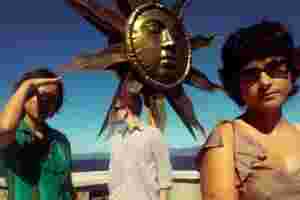
Interview The Orielles: In Contrast
Four albums and almost ten years in, The Orielles’ new LP ‘Only You Left’ is a tale of two halves that sees them continue their evolution as one of Britain’s most intriguing outfits.
‘Only You Left’, the fourth album by The Orielles, is an album of contrast. Half recorded on a Hamburg industrial estate, half on the Greek island of Hydra, it bears both tightly-wound, machined grooves and languid, unravelling refrains and, in turn, more clearly than ever takes the band from their 2010s indie beginnings to somewhere else entirely.
Made up of Halifax natives and sisters Sidonie and Esmé Dee Hand-Halford alongside Henry Carlyle Wade, the origins of ‘Only You Left’ lie in the trio’s pragmatic approach to writing and rehearsing amongst the realities of the music industry today. “Because of the way we work and live our lives, we have collective days off at the beginning of the week,” explains Henry, “and that was when we’d be writing. Then we’d all go off and live our lives, work our jobs, mulling over these phone recordings and when we’d come back, we’d have a list of ideas of where to take songs. It really felt like in the early days, what we were most attracted to was just the three of us playing, and trying to find a pure expression of how we were feeling and what we were going through.”
It’s always hard, really, to hear The Orielles’ work as that of just three people - Henry’s guitar joined by Sidonie’s percussion, and Esmé’s bass and ethereal voice. The band create wide open spaces within these relatively restrictive confines, with songs ebbing and flowing towards crescendos that bely their number. “That was what was most exciting,” continues Henry, “these big dynamic shifts, and then emptiness. I remember us getting obsessed with the musical idea of things changing suddenly, and then never being able to go back to how they were.”
“I’d never heard real silence before, until an evening on Hydra.”
— Sidonie Dee Hand-Halford
This time, the band set out to approach recording with specific spaces in mind while writing. They eyed up two studios in particular: a state-of-the-art space in Hamburg, and a relatively rudimentary one on Hydra, a Greek island. “The record in its initial stages required quite a lot of imagination,” recalls Esmé. “Each of us had these ideas of these spaces we’d not been to yet, and the sounds we were going to create or attain in those spaces.”
“When we found these two really contrasting things, it gave us a theme,” adds Henry. “Something to chew on, in terms of this duality that then became more and more extreme as we imagined what would be recorded where - how different a song would be if it was recorded in Greece or Hamburg.”
The first leg of recording, in Germany, sounds like an almost monastic experience. “Hamburg was very far out of the centre, on the fifth floor of this warehouse,” says Henry. “We lived on the floor below, which meant we hardly left - to go to the shop to buy beer and fags, or to go to Der Kebab.” This lack of outside distraction led to a deeply productive time for the band - and for their longtime collaborator, producer Joel Anthony Patchett. “We kind of smashed it in Hamburg, to the point that when we got home we were like, ‘Oh, fuck, what are we actually going to do in Hydra?’” grins Henry. “But I personally believe that the record came into its own, because what came out of there completely filled in the other half of the contrast.”
So, to Greece, where despite “trying to avoid the holiday bragging” (as Henry puts it),
the band relay an idyllic time, spent pushing deeper into the world they were creating, in a place with a dreamlike sense of calm. They recorded in a single room, and stayed on the other side of the island. “Every morning we had to walk across this port, which was such a great ritual. Have an espresso and a spanakopita on the way up. There was an island- wide noise curfew, so we could work until three in the afternoon, and then there was a compulsory no noise until five or six, siesta type thing.” He pauses to smile. “So we were basically forced to go and swim at that time, because we couldn’t make noise. Then we’d just hammer the session until ten or eleven each night, and go and get some scran in the town.”
“On Hydra, as well, it’s a completely car-less island,” explains Sidonie. “The complete lack of noise pollution because of that was crazy, I’d never heard real silence before, really, until an evening on that island.” There’s a genuine sense that this was a truly special shared moment for the band. “Basically the whole island was our studio in a sense, because when we’d be recording you could hear reverberations bouncing off the buildings all around us. We actually leaned into that quite a bit, and ended up recording the sound of Henry’s guitar, but from a mile away. It was really beautiful.”

“[Success] is about connection: all these people that you wouldn’t have shared something with, if we weren’t making music.”
— Esmé Dee Hand-Halford
The result is eleven songs with a distinct sense of space, a peek into the centre of the band’s world, as if at the centre of where they’re playing. Underlying all that is the trio’s bond - there aren’t many bands The Orielles’ age who can claim fifteen years of shared history. “It’s just always been such a weekly ritual,” Henry reflects. “To make music, the three of us - forever. Through high school, university, and then young adult life, it’s been the grounding anchor.” Esmé smiles. “I really enjoy the slowness of it as well. I do believe that good things are slow - they take their time, and there’s more longevity to it. To get to the point where we’ve had these amazing studio experiences - I mean, maybe if we were on a major label we might have had that long ago. But it’s nice to be able to discover these things, after so much time, with my two best friends.”
What, then, is success for The Orielles? “People define it as a monetary thing,” replied Henry. “We don’t. Being able to live off music is essentially an unattainable goal with the way the industry works now, so being able to do it at all is pretty successful, we reckon. It’s more of a question of people taking their own things out of it that excites us. Some of the stories people have told us about their personal connections to the songs are quite overwhelming and completely life-affirming.” Esmé smiles. “It’s about connection: all these people that you wouldn’t have had the opportunity to have conversations with and have shared something with, if we weren’t making music.”
Four albums and fifteen years in, The Orielles are continuing to create oblique, beautiful music entirely on their own terms. ‘Only You Left’ is a document of many things - the places it was recorded, the experiences of the band who wrote it - but more than anything it’s a reflection of the deep bond between Esmé, Henry and Sidonie. In fact, the album’s opening track is called ‘Three Halves’ - an apt description of The Orielles’ own.
‘Only You Left’ is out now via Heavenly.
Records, etc at


As featured in the March 2026 issue of DIY, out now.

More like this
The Orielles - Only You Left
3-5 Stars
A circle completed? Not quite — The Orielles have never dealt in such concise shapes.
11th March 2026
The Orielles reveal next LP preview ‘Tears Are’
The Manchester trio’s fourth album is out next month.
12th February 2026
The Orielles preview fourth album ‘Only You Left’ with new double single
‘You Are Eating A Part Of Yourself’ and ‘To Undo The World Itself’ are the experimental latest offerings from the Manchester trio.
12th January 2026

Baxter Dury, Sleaford Mods and Fat White Family shake up the scenery at South Facing’s first weekend
The month-long new Crystal Palace festival is a fresh gem in London’s summer calendar.
8th November 2021

Featuring Finn Wolfhard, FLO, Jungle, Mystery Jets and more.