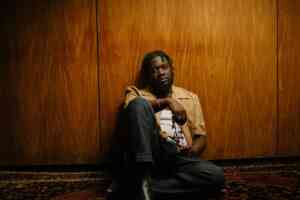
Michael Kiwanuka: Changing Seasons
Since the release of 2019 third album ‘KIWANUKA’, its eponymous author has won the Mercury Prize, become a father twice over and wrangled a new sense of self-confidence in his own decisions. New album ‘Small Changes’, then, is the result of some altogether bigger ones.

“I’m no longer just trying to shut my eyes and survive,” Michael Kiwanuka explains, calling whilst in transit from Paris. “Now I really cherish, endure, enjoy and savour the moment.” When DIY catches the singer-songwriter, he’s just experienced a particularly notable one of those moments. Mere minutes before, his new album ‘Small Changes’ was announced to the world. “It’s a mad feeling,” he beams as the French capital whizzes by in the background. Is it still the same rush, fourth time around? “It still feels just as exciting and thrilling. It’s the reminder that, ‘Oh my gosh, I get to do this for a living’,” he nods. “Before, I’d fixate on all the things that are going wrong, but now I’m way more [present].”
This newfound ability to open up the aperture seems to have been fuelled by a number of notable life and career changes. Kiwanuka enjoyed a career high in the communal low of COVID, picking up the Mercury Prize for his triumphant, self-titled LP ‘KIWANUKA’ in 2020. Though the celebrations took place in something of a lockdown-imposed, diluted atmosphere, its effect on the singer was reinvigorating. “I took loads of confidence out of that strange time. I didn’t expect to win and realising people were really listening to this music was really exciting,” he reflects.
His realisation clearly trailed behind that of the rest of the world. Kiwanuka bagged the BBC Sound award on his debut back in 2012; his sophomore release ‘Love & Hate’ topped the charts, plus he stands alongside a select few artists who’ve racked up three Mercury nods - a 100% success rate for every album he’s released. Modesty has always been a key thread of his calm, considered personality, which often stands at odds with the attention around him, and it’s this outlook that has rewarded Kiwanuka with a certain level of anonymity despite his success; a raw talent with his feet firmly on the ground. Rather than relying on an invented persona or trend-hopping to sell his music, he appears to be entirely dedicated to serving the songs - but now, that inbuilt modesty interlocks with a newfound confidence.
In 2022, he embarked on a postponed tour which allowed him to experience something of a startling career jump. “The crowd and the size of the venues had completely changed from before, it was an amazing feeling. You get the wind in your sails and start to create more and get excited. It proved to me that following your own nose actually works.” He pauses. “And then the world’s your oyster.”

During that period, Kiwanuka’s nose was telling him to focus on the bigger picture. “For the first time, I felt like I didn’t have to prove myself through every single note,” he suggests. “The energy of that album was to prove that I was an artist who was worth people’s time and ears. There was a lot I wanted to say that people maybe necessarily didn’t know I had in me.”
The album triumphed with its defiant exorcism of identity, politics and love, seeped in all the pain, confusion and joy that comes pre-baked into those topics. His Ugandan surname was centred all-caps on ‘KIWANUKA’ for a reason: once upon a time, professionals around him in the industry suggested changing his surname to improve his chances of breaking through. On the joyously rattling ode to self belief ‘You Ain’t The Problem’, he broke free of the self-doubt that often plagued his early career: “I lived a dream / I hope to be who I believe in / I used to hate myself, you got the key / Break out the prison,” he sang. Fourth LP ‘Small Changes’ was forged in the cathartic afterglow of that time.
“It’s an album I wouldn’t have had the confidence to do five or 10 years ago,” he muses. “I wanted to focus on my voice, the songs and the space; if it was 10 years ago I would have had a different attitude, throwing in fast guitars, strings and choirs. That’s not to discredit the sound of those records - there’ll be albums like that again - but I’m not in that headspace now.”
While the bombasity of orchestras and choirs have their place, it’s dialled down on ‘Small Changes’, contributing to a sparser atmosphere which pulls focus to the drums, guitar, bass and vocal. The strings underline rather than overstate; their measured application recalls Arctic Monkeys’ ‘The Car’ at times. As a result, the songs here reveal themselves over repeated listens - not quiet, but rawly purified. ‘Lowdown (part i)’ is a stripped back shuffle, simmering with a demo-like quality which is gently warmed by a glowing organ and a terrific, buzzy guitar solo.
This intimate backdrop provides a perfect accompaniment to lyrics that are largely preoccupied by the smaller things in life - perhaps owing to the fact that Kiwanuka and his wife are now parents twice over. The album reveals small peeps into domesticity, the title track swirling in the heavy atmosphere of an expecting couple; “All this time we knew there was something in the air,” he sings over strikes of glimmering keyboards and a dusty drum beat.
Opener ‘Floating Parade’ finds his perspective shifting. “I’ll be a full-on child for a while,” he sings against the gentle thrum of an acoustic guitar. Background harmonies and strings subtly surface like a magic trick, giving the sensation of a pupil widening. “I wanted to write [about] this time with that wide-eyed view of the world,” he explains. “It’s about having a young family, but it’s also about getting older.” That perspective is refracted by the album’s stark cover, which cranes down towards a young boy, two different hands reaching out to him. “It looks like he doesn’t know which way to go,” he offers. “It’s a gripping photo.”


While parenthood clearly seeped into Kiwanuka’s songwriting thematically, its round-the-clock commitments also provided some unexpectedly useful creative parameters. “You don’t have as much time, so you basically learn to trust your intuition more and follow the first initial feeling or idea straight away,” he reflects. “Whereas before I had a lot of time to sit and ponder it, start doubting it, try something else just in case - endless options. I’d end up not doing anything for like, two hours, and a lot of that is nerves because you don’t want to listen back to something that’s not working. You don’t want to face the music - literally.”
The responsibility of parenthood brushes shoulders with the counterbalance of childlike play across the record’s creation. “When you go to a studio and you think you KNOW the thing, it’s quite hard to MAKE the thing,” he suggests. “The cool and clever idea you thought you had isn’t usually that good. Creativity is always best when you view it like a kid; it feels like that’s when you’re yourself.”
This was channelled into the “roll up and see what happens” philosophy in the studio with collaborators and producers Danger Mouse [Gorillaz, Adele, Red Hot Chili Peppers] and Inflo [Sault, Little Simz, Cleo Soul]. “It used to terrify me years ago,” he confesses. “Those two are big characters, you know? So when you’re in the studio it can be intimidating. This time wasn’t any easier particularly, but that mindset of being free and trusting your intuition places less pressure on yourself.”
Danger Mouse and Inflo have been a crack team of sorts for Kiwanuka since 2016’s ‘Love & Hate’; ‘Small Changes’ marks their third outing together. Is there any secret to their chemistry? “We don’t know,” he shrugs. “It just happens, which can be frustrating because you can’t force it, there’s no real technique and methods. It’s about sitting there being present. If we let each other be each other, it works. If we try to be somebody else, it doesn’t. I definitely wanted to get to a trilogy [with them] because that feels right. That was that era, and there might be another era.”
Despite some of the retro callbacks and nods in the album’s production, the trio’s work together consistently oozes with a timeless quality. It’s a product seemingly achieved by a mental trick Kiwanuka wanted to impose on the recording process: shedding the metric of “cool”. “I remember asking Flo [Inflo] - what would an album be like if you took away that feeling of trying to be cool,” he recalls. “You think of songs like ‘Lovely Day’ or what people play at weddings. They’re great songs and people love them while you’re busy trying to be the coolest dude. This is the album of trying to get to that place, [where] you’re being so intuitive that you don’t even care if it’s cool or not, you’re just going for what moves you. I think that might have subconsciously governed the production too.”
This mindset shifted the in-studio debates from ‘What’s the best snare sound for this track?’ to ‘What’s the most beautiful melody for this section?’ or ‘What’s the best chord change for this transition?’. “Once you’d found that,” Kiwanuka says. “The rest didn’t matter.”
The confessional ‘Live For Your Love‘ emanates this approach. Structurally shed of all fat and led by a gorgeous melody countered by sweeping strings, again and again Kiwanuka seems to strike on ideas left unplucked by the greats. The musicianship thrives despite the reduced sonic palate Kiwanuka allowed himself access to - a result in no small part owed to playing alongside the world’s best including legendary bassist Pino Palladino (who’s played with everybody from The Who to Beyonce and D’angelo) and Jimmy Jam (producer of 16 US Number One’s for the likes of Janet Jackson, George Michael and Mariah Carey).
“The song ‘Rebel Soul’ is my idea of a supergroup,” Kiwanuka grins. “Flo on drums, Brian [Danger Mouse] producing, Pino on bass and Jamz playing organ. My fantasy league team together - that was a real pinch yourself moment.” The resulting track is an enveloping, warm rumination, soundtracked by a fluttering piano hovering above crunchy drums and a stark wandering bassline.
For all the talk of confidence, ‘Small Changes’ doesn’t necessarily evoke jubilance to the outside ear. But, for Kiwanuka, there’s joy in the stripped-back moments. As conversation turns to his Glastonbury set this year, he recalls the difficulty he had adjusting from the intimate trappings of the indoor gig circuit to big outdoor spaces. “I used to be really intimidated by festivals,” he recalls. “You’re trying to fill up this space with intimate music while there’s other bands playing louder, faster music.” In amongst the folkier sonics of his first album, however, the audience would often be breathlessly suspended in space and time by the fragile songcraft. “I love the silence,” he decides now. “It’s the louder, faster, noisier bits that took me longer to work out how to do. I’m glad it’s taken a while to build up. If it got to big stages straight away, it would have just been too much”.
Indeed, it feels as if Kiwanuka is trying to reclaim the silence somewhat across ‘Small Changes’. Even on the Pyramid Stage, billed just before Little Simz and Coldplay on a sun-kissed June afternoon, the atmosphere he created was a notably, purposefully tender one. Attired in traditional Ugandan dress, on the background screen montages of families embracing one another slowly unfurled, circulating a feeling of intimacy in these most impressive of settings. While the scene of the stage was striking, meanwhile, the outward view was just as spellbinding for Kiwanuka himself. “It’s a unique sight that you don’t see everywhere you go, looking out at the flags under the weather we had - it’s a unique moment, once in a lifetime,” he smiles. “A totally unique experience that I’ll never forget.”
As for Kiwanuka’s own young family, it appears that his kids are slowly starting to understand what their dad does for a living. “They’ve come to some gigs. For them it was like, ‘Oh wow, there’s loads of people there’. I don’t think they’re at the age where it makes a whole load of sense. It’s more fun for them to go to the park and play football rather than listen to my album,” he laughs. “Which is a good thing, I’ve got my feet firmly on the ground. I’m not walking around acting like Prince, you know?”
‘Small Changes’ is out 15th November via Polydor.
Read More

Kelela: Fear The Future
Having become renowned as one of music’s most cutting-edge but fluid visionaries for well over a decade, on her dystopia-fuelled third album ‘new avatar’, Kelela is both returning to her roots, and looking firmly ahead.

Yard Act: The Perfect Antidote
They’ve burned the Rover and built their own studio - three albums deep, Yard Act aren’t resting on their laurels. Now returning from LA with a new record in tow, James Smith and Ryan Needham talk to DIY about self-awareness, finding their sound, and just why we all need a little music right now.

Maisie Peters: Seasons Change
After a series of high profile support slots and live shows around the effervescent pop of last LP ‘The Good Witch’, Maisie Peters found herself ready for a gear change. With her third album ‘Florescence’, she’s dug a little deeper and found contentment in the more intimate moments of life.

Wolf Alice: Park Life
One of their generation’s greatest indie success stories, with latest album ‘The Clearing’ Wolf Alice have well and truly conquered the big leagues while always staying true to their roots. Returning to North London this summer for the fullest of full-circle moments, the band are rounding out their victory lap the only place possible - with a hometown turn at Finsbury Park playing their biggest ever headline show.